Hot tub gazebos · Fraser composite
Shelter the tub. Salvage the winter. Keep the spa useable all year.
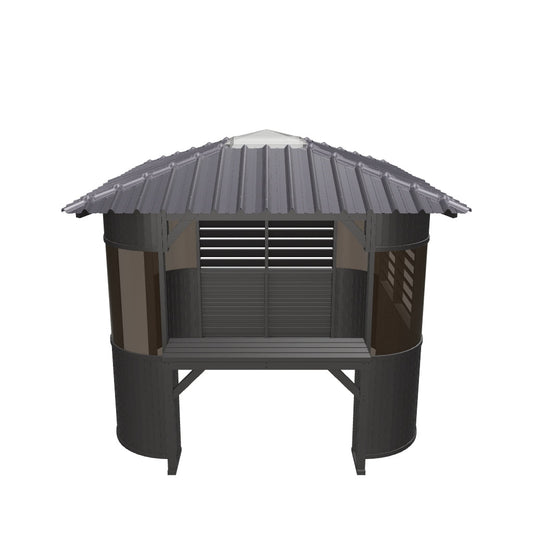
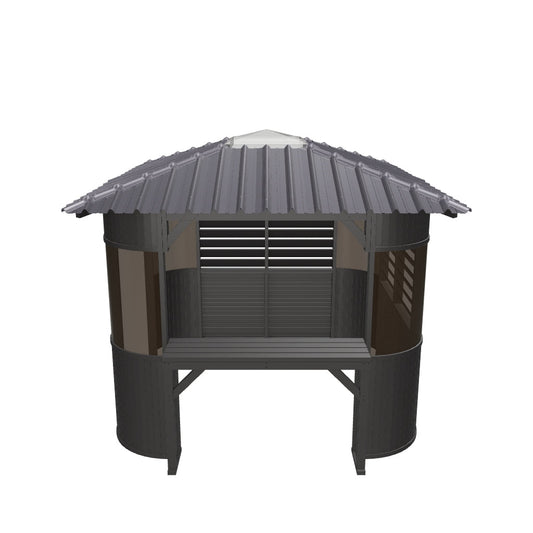
A proper UK hot tub gets used twelve months of the year — but only if you've dealt with the thing that actually kills usage, which is the walk from the back door to the water in sideways rain. The Fraser is our freestanding composite gazebo: a 305cm-square enclosure with a sloped roof, a central skylight, two covered sides for shelter, two open sides for access, and a built-in bar with three stools.
Composite frame, not timber. It doesn't rot, doesn't need re-staining every two years, and will outlive the second tub you put underneath it. Fits any hot tub up to 228 × 228cm — which covers the vast majority of our hard-shell range, plus most of the UK 4–6 person market.
Why the Fraser, specifically
'Hot tub gazebo' is a category that sells a lot of wooden cubes that don't last five British winters. The Fraser is engineered around four facts — the frame, the fit, the sightlines and the install path.
-
Composite frame — not timber
The Fraser is built from a heavy brown composite plastic: UV-stable, weather-stable, dimensionally stable. It doesn't rot, doesn't warp in UK winters, doesn't need an annual re-stain or a yearly coat of preservative. A wooden gazebo at this size is a maintenance contract you've signed without reading it — stripping, sanding and treating every two or three years for the life of the structure. Composite skips the whole conversation. It arrives brown, it stays brown, and a jet-wash once a season is the full maintenance routine.
-
Designed around the tub
305 × 305cm external, 270 × 270cm internal, with enough ceiling height (295cm) that the cover lifts without fouling. Takes any hot tub up to 228 × 228cm — the vast majority of our 4–6 person hard-shells fit, including the Toronto SE. You need a level 3.5 × 3.5m base to assemble on. If your tub is bigger than that, or a swim spa, this isn't the enclosure for you — talk to us and we'll point you at a bespoke build.
-
Light above, privacy around
A central skylight in the sloped roof means the interior doesn't feel like a shed — you get real daylight over the tub even with the cover closed. Four rounded smoked-acrylic corner windows cut glare and overlooking neighbours' sightlines without blacking out the space. Two of the four sides are covered panels (weather-facing); two are open for easy access in and out. Orient the covered sides to your prevailing wind and you've got shelter where you need it, without the claustrophobic feel of a fully sealed enclosure.
-
Kerbside delivered — pro install optional
Free kerbside delivery to mainland UK. Two competent adults can assemble the Fraser over a weekend; the clasp-fit composite panels don't need specialist tools. If you'd rather not, our UK installation service will do the job for +£1,000 — everything from base check to bar stools in position. It's the one big bit of kit in the garden where 'professional fitting' genuinely shaves a day off your weekend, and we'd rather quote it honestly than pretend it's a 30-minute flat-pack.
Gazebos Buying Advice
Use this collection to compare specifications, delivery options, and aftercare before you buy. Contact our UK support team for help choosing the right model for your space and budget.
-
Ex-Demo Fraser Freestanding Gazebo 305 x 305 x 295cm
Regular price £2,999.00Regular price£4,995.00Sale price £2,999.00Reduced -
Fraser Freestanding Gazebo 305 x 305 x 295cm
Regular price From £3,750.00Regular price£4,995.00Sale price From £3,750.00Reduced


Gazebos: UK Buying Guide
This collection is part of the Canadian Spa Company UK range of hot tubs, swim spas, saunas and spa essentials. Compare options by fit for your space, running costs, insulation, warranty and ongoing maintenance requirements to make a better long-term choice.
If you need help choosing the right model or part, our support team can guide you on compatibility, delivery and aftercare.
Why bother
What a gazebo actually changes about owning a hot tub
Most hot tub owners in the UK underuse their spa for the same reason — the journey to the water in bad weather. An enclosure isn't a luxury; it's the single biggest lever on how often you'll actually sit in the tub.
-
Turns a summer tub into a year-round tub
The unused-hot-tub-in-January problem is almost never the water temperature — the tub holds 38°C fine. It's the ten-metre sprint through cold rain from the back door to the cover. Shelter that journey and the tub gets used in December, in February, on the wet Friday nights in November when the alternative was staying indoors. That's the whole case for an enclosure — it multiplies the use you get from a spa you already paid for.
-
Privacy that doesn't feel like a shed
A lot of UK gardens have a direct sightline from an upstairs window next door. Solid fencing fixes that, but a 6ft fence ring around a hot tub is ugly and blocks winter daylight. The Fraser's covered side panels plus smoked corner windows solve overlooking from the right angles without killing the light or the garden view — a much smarter geometry than a fence.
-
Real weather protection over the tub itself
Two covered sides oriented toward the prevailing wind plus a sloped, skylit roof means you can sit in the tub in rain and soft snow without the water surface being peppered. The tub cover stays drier when it's off; the control panel stays drier when you're hitting buttons in the wet; and the pillows don't end up sodden from an afternoon shower you weren't home for.
-
Cleaner water between changes
An open-air hot tub under a tree catches leaves, pollen, insects and the fine grit that blows off everything in late autumn. All of that ends up in the filters, and you end up changing them more often and draining the tub sooner. A roofed enclosure cuts the airborne debris reaching the water by a large margin — filters run longer between rinses, the water stays clearer, and you buy fewer cartridges over a year.
-
Built-in bar and three stools
Included, not an upsell. The integrated bar gives you somewhere to park a towel, a drink, a tablet playing something, without balancing anything on the tub edge. Three stools so a couple of friends can sit and talk to whoever's in the water. It's a detail that costs nothing on top of the gazebo price and changes how the space gets used — the tub stops being a solo appliance and becomes the centre of a small outdoor room.
-
No staining, no rotting, no annual job
The hidden cost of a wooden gazebo is the labour. Every two or three years, strip it, sand the bad bits, brush on two coats of preservative, wait for dry weather between. Miss a season and the cheapest wooden gazebo starts turning silver-grey and pulling apart at the joints. The Fraser's composite doesn't ask for any of that — the one annual job is a jet-wash, and you can skip it most years if you can't be bothered. Whole-life cost is lower than a cheaper wooden unit by year five.
Common questions
Hot tub gazebo FAQ
Will my hot tub fit inside the Fraser?
If your tub is 228 × 228cm or smaller in footprint, yes. That covers the vast majority of our hard-shell range — including the Toronto SE, the Great Lakes series and most 4–6 person models — as well as most competitor tubs at that size class. If your tub is larger (a big 6–7 person family spa, any swim spa, some of the imported import-brand hex-shells), the Fraser isn't the right enclosure; get in touch and we'll either confirm fit with the exact tub dimensions or recommend an alternative.
Don't just measure the water footprint — include the full shell, the steps and the cover lifter if you're keeping one. And leave a few centimetres on each side for assembly tolerance.
Why composite rather than a cedar or pine wooden gazebo?
Wooden gazebos in the UK market tend to be treated pine, redwood or cedar. They look handsome on day one and they look a lot less handsome by year five — UK damp gets into joints, the wood moves between wet and dry spells, and without a serious re-staining schedule every two to three years they start silvering and splitting. A full restore costs labour and, if you pay for it, several hundred pounds.
The Fraser's composite frame is UV- and weather-stabilised. It doesn't absorb water, doesn't rot, doesn't need re-coating, and doesn't move seasonally. A cedar gazebo might look better on day one; the Fraser will look the same as day one in year ten. That's the trade-off.
Do I need planning permission?
For the vast majority of English, Welsh and Scottish domestic gardens, a freestanding gazebo at 305 × 305 × 295cm falls within Permitted Development rules as an 'outbuilding' — no planning permission required. The usual caveats apply: you need to be more than 2m from a boundary for the 2.95m height, and if your property is listed, in a conservation area, in a National Park or is a flat/maisonette, Permitted Development may not apply. Check with your local planning authority if you're not sure. We don't submit applications on your behalf, but we can supply full dimensioned drawings for an application if needed — just email the support team.
What base do I need?
A level, load-bearing 3.5 × 3.5m area. That's typically a concrete pad, close-jointed paving slabs laid on a proper bed, or a purpose-built reinforced spa pad. Direct onto grass or soft ground doesn't work — the structure needs to remain level for the doors and side panels to sit true, and soft ground settles unevenly in the first winter.
The base needs to carry both the gazebo and the filled hot tub inside it, which is a combined static load of several tonnes. If you're pouring a new base, spec it for a filled spa, not a garden ornament — ask a landscaper for 100mm+ concrete on a compacted sub-base, or match what the tub's own installation guide recommends.
Can I install it myself?
Yes — two competent adults, a weekend, and standard hand tools. The composite panels use a clasp-fit assembly designed to go together without specialist kit. The instructions are decent; the slowest part is usually getting the first corner true.
What catches people out is the base prep, not the assembly. If the 3.5 × 3.5m footprint isn't properly level before you start, the panels fight you on the final joins and the doors don't sit right. Spend the time on the base. If in doubt — or if the hot tub's already in position and you don't want to empty it to fit the gazebo around it — take our £1,000 installation service. We'll handle base check, full assembly and the bar stool set-up, typically in a day.
How long does assembly take?
DIY, with two people on a level pre-prepped base: expect a full Saturday for the frame and roof, plus a couple of hours Sunday morning for the side panels, windows and bar. Bank on a weekend, not an afternoon. Professional install is usually one working day on site — we arrive, we finish, we leave.
Plan the install for a dry spell if at all possible. Handling composite panels in sideways rain is unpleasant and the roof joins seat more cleanly dry.
Will the gazebo keep the tub warmer in winter?
Marginally. The Fraser is a shelter, not a sealed heated room — two sides are open by design, so you're not adding insulation around the tub. A well-insulated hot tub loses heat mainly through the cover, not through the cabinet side walls, and the cover is what it is regardless of whether there's a gazebo above it.
What the gazebo does do is keep wind-driven rain and snow off the cover itself, which keeps the cover dry and its foam interior from getting waterlogged over a bad winter — and a waterlogged cover is the single biggest cause of rising running costs in year three of owning a tub. So: small direct heat retention benefit, meaningful indirect protection benefit. Both matter, but it's the cover protection that makes the numbers work long-term.
Is the roof fully waterproof?
The sloped composite roof sheds rain and light snow reliably, and the central skylight is sealed. The gazebo isn't designed to be a watertight room — with two open sides, wind-driven rain at an angle can reach the tub. In practice that's a rare combination (it takes wind direction lining up with the open sides), and you can adjust which two sides are open at install to match your prevailing weather.
Think of the Fraser the way you'd think of a bandstand or a covered pergola: it shelters the space above and behind the tub, not a sealed box around it.
Can I close all four sides?
Not with the standard build — the Fraser is specified as two covered and two open sides, and the two open sides are structurally part of the access design. Fully enclosing a gazebo around a hot tub is not something we recommend anyway: hot tubs vent warm humid air continuously, and in a sealed structure that condenses on every internal surface, soaks the cover and drives mould growth in the ceiling. Partial enclosure is the correct answer for almost every UK buyer; if you need a sealed structure, you want a hot tub room, not a gazebo.
What warranty does the Fraser carry?
Standard 12-month manufacturer warranty on the composite panels, roof structure and hardware against manufacturing defects. Consumables (the bar stool cushions, any trim) aren't covered beyond the DOA period. UK warranty support is handled from our Redhill, Surrey office — same team that looks after the hot tub range.
How is it delivered, and how long does it take?
Free kerbside delivery to mainland UK. It arrives on a pallet via a dedicated carrier, typically within 7–14 working days of order depending on stock — exact timing is shown on the product page. You'll need enough access to get a pallet off the truck and onto your property; a standard drive or side passage is fine. The driver won't take it through to the garden for you, but they will get it off the truck at the kerb.
If you're booking the professional install option, we coordinate the install visit to follow the delivery — usually within a week of the pallet landing, so the gazebo isn't sitting outside wrapped up for long.
What's the difference between the full-price and ex-demo Fraser?
Ex-demo units are Fraser gazebos we've had assembled for trade shows or customer viewings — fully functional, visually near-perfect, but not technically new. Saving vs full retail is meaningful (around £750 off). If you want pristine factory-fresh packaging, take the full-price option; if you're happy to take a gazebo that's been stood up and taken down once in a controlled environment, the ex-demo is materially the same product at a lower price. We QA each one before despatch and flag any cosmetic marks in the listing.
UK buying guide
Hot tub gazebos UK — buying guide
A hot tub enclosure is the single best lever on how much you actually use the hot tub you've already paid for. In the UK climate — five or six wet months a year, a dark half of the year when 'going outside' needs a reason — the spa gets used when the route to it is sheltered and the journey is short. When it isn't, the tub sits covered and idle from October to March, and owners quietly reappraise whether a hot tub was worth it. It was. The gazebo is what fixes the use-rate.
The first question: does your tub fit?
The Fraser takes any hot tub up to 228 × 228cm in footprint. Measure the shell (not just the water area), include the steps if they're integrated, and allow a few centimetres of tolerance each side for assembly. Most of our 4–6 person hard-shells — including the Toronto SE — clear that envelope. A handful of 6–7 person family tubs, any swim spa, and some larger imported models don't. If your tub is bigger than the envelope, the Fraser isn't the right product — and no amount of forcing the fit will fix it. Email the support team with your tub's exact external dimensions and we'll either confirm it fits or recommend an alternative.
Composite frame vs wooden frame — what you're actually choosing
The UK hot tub gazebo market splits into two camps: composite (the Fraser is one) and wooden (cedar, pine, redwood). Both have a role; they optimise for different things.
Wooden gazebos look beautiful on day one. They also need a maintenance contract. Every two to three years you're stripping, sanding the bad bits, brushing on two coats of preservative in the single dry week you can find, and hoping you timed it right. Miss a cycle and the joints start separating, the colour goes silver-grey, and the warranty won't cover what's effectively accelerated weathering from neglect. The cheapest wooden gazebos look terrible by year five. A good cedar build done properly can look handsome for a decade — if you're prepared to put the hours in.
Composite gazebos — the Fraser's category — are dimensionally stable, rot-proof and UV-stabilised. They arrive brown, they stay brown, and the entire annual maintenance routine is 'jet-wash it once, skip it if you can't be bothered.' The trade-off: the aesthetic is industrial-honest rather than pretty. If what you want is a garden feature that photographs well on a summer afternoon, a cedar build might edge it. If what you want is a reliable shelter that keeps the tub useable for the next ten winters without a single weekend spent on maintenance, composite is the correct choice every time.
Why we don't recommend fully enclosing a hot tub
A question we get regularly: 'Can I just build walls on all four sides so the tub's sealed?' The answer is technically yes, practically no. Hot tubs continuously vent warm, humid air — that's physics, not a fault — and in a sealed enclosure that moisture has nowhere to go. It condenses on the ceiling, drips back down, soaks the cover, and within one winter you've got mould growth in the roof timber or panels and a waterlogged cover.
The Fraser's two-covered-two-open design is deliberate. It shelters the space above and behind the tub (where you want the weather protection) while leaving enough ventilation that humidity escapes rather than condensing. You orient the covered sides toward your prevailing wind at install. If you genuinely need a fully sealed space for a hot tub — which is unusual for a domestic setup — you want a hot tub room with proper mechanical ventilation, not a gazebo. We can point you at that conversation separately.
What a gazebo does not do
It doesn't meaningfully reduce running cost. A well-insulated hot tub loses heat through the cover, not the cabinet walls, and the cover is what it is whether there's a roof above it or not. You might see a small benefit from the cover not getting waterlogged over winter (which preserves its insulation over time), but the daily electricity bill will look the same. Sellers who quote specific winter-running-cost savings from adding a gazebo are making numbers up.
It also doesn't replace a tub cover. Even a fully sheltered tub still needs its hard-top cover on when not in use, for heat retention and for the safety of anyone walking into the garden. The gazebo shelters the cover; it doesn't substitute for one.
Base, planning and install — in that order
Three things to sort before ordering: the base, whether you need planning, and who's fitting it.
- Base: level, load-bearing, 3.5 × 3.5m minimum. Concrete pad, close-jointed paving, or a proper spa pad. Not grass. Not decking unless the decking is rated for the combined static load of the gazebo plus a filled hot tub inside it — which most domestic garden decking isn't.
- Planning: for almost all UK domestic gardens, a freestanding 2.95m-tall outbuilding at this footprint falls within Permitted Development. Caveats apply for listed properties, conservation areas, National Parks and flats. If in doubt, ask your local authority; we can supply dimensioned drawings for a planning application if you need them.
- Install: DIY over a weekend with two adults if you're confident with flat-pack work, or professional install for £1,000 if you'd rather someone else handled it. Either is fine; both produce the same result if the base is right.
Why buy from Canadian Spa Company
We've been a UK hot tub specialist for over 35 years. The Fraser sits in our Redhill, Surrey warehouse, and when something needs sorting — a delivery question, a replacement panel, an installation query — you're phoning the UK office that handles the hot tubs, the swim spas and the saunas, not a reseller's email address that takes three days to reply. That's the part of the hot tub gazebo category most online listings can't offer, and it's the thing that actually matters in year three.
Frequently asked
What's the best hot tub gazebo UK?
The best gazebo is the one that fits your specific tub, survives a UK winter without a maintenance contract, and sits on a base you can actually provide. For 4–6 person hard-shell tubs up to 228 × 228cm, our Fraser composite gazebo is the straight answer — rot-proof frame, skylit sloped roof, integrated bar and three stools, £1,000 professional install available if you'd rather not do it yourself. Browse the full UK hot tub range at our hot tubs collection.
Wooden hot tub gazebo vs composite — which is better?
Composite wins on maintenance, longevity and whole-life cost. Wooden wins on day-one aesthetics if you maintain it properly. For most UK buyers who want the tub useable all year without spending weekends on preservative, composite is the honest recommendation. The Fraser is our composite option.
Can I build a hot tub room instead of a gazebo?
You can, and for some properties it's the right answer. A proper hot tub room is a sealed, mechanically ventilated structure — fundamentally different from a gazebo. It's also materially more expensive, needs building regulations approval for anything that connects to the house, and requires specialist ventilation to avoid mould and condensation. For the vast majority of UK domestic setups, a covered-but-ventilated gazebo is the right balance of cost, install speed and weather protection. If you specifically need a room — for a commercial setting, a wellness space, or an exposed rural site — we can advise separately; contact the UK support team.
How do I check if my hot tub fits a 228cm gazebo envelope?
Measure the external shell of the tub at its widest point (not the water surface), front-to-back and side-to-side. Include any integrated steps and the cover when it's in the closed position. Add 5cm on each side for assembly and access tolerance. If the larger of those two measurements is 228cm or under, the Fraser fits. If you're unsure — or your tub is an older model without published external dimensions — email support with photos and a tape-measure reading, and we'll confirm fit before you order.
How quickly can you deliver a Fraser gazebo?
Typically 7–14 working days from order to kerbside delivery on mainland UK, subject to stock and carrier availability. Exact timing is shown on the product page at the point of order. Professional installation, if booked, follows delivery by up to a week — we coordinate the two so the pallet isn't sitting wrapped outside your property for long.