Plug-and-play inflatable hot tubs
A real hot tub, out of the box, on a standard plug.
Unbox, inflate, fill from the hose, plug into a 13A socket — heating within the hour. No installer, no rewiring. You will need a level, load-bearing patio underneath; a filled tub is close to two tonnes.
What sets ours apart from the high-street end of the category: a real vinyl insulation wrap around the body — not a printed two-tone that imitates one — and 74cm of depth. Proper neck-and-shoulders submersion, less surface area losing heat, built to run through a British winter.
What makes a Canadian Spa inflatable different
Most of what's marketed as an 'inflatable hot tub' on the UK high street is a bubble-walled paddling pool with a heater strapped on. Ours are built to a different spec — here's what that means day to day.
-
Runs from a full 13A outdoor socket
No dedicated 32A circuit, no rewiring — an outdoor-rated UK 13A socket on a healthy RCD-protected circuit is all you need. One caveat worth being honest about: the tub will draw close to the full 13A when it's heating, so the socket genuinely needs to be able to deliver it. A patched-together supply, a tired ring main or a long indoor extension lead through a window will stall the heat-up — fix the socket before the tub arrives.
-
Unboxed and inflated in under an hour
Lay the tub on an existing level, load-bearing patio (a filled tub is close to two tonnes — see the base FAQ). Attach the control unit, inflate in about 10 minutes with the supplied pump, fill from a garden hose, plug in and start heating. First fill to 38–40°C takes 18–24 hours on most models — not because the tub is broken, because the heater is raising two tonnes of water from cold.
-
Real vinyl wrap + 74cm depth — built for UK winter
Where high-street inflatables rely on a printed two-tone panel styled to look insulated, our tubs have a genuine vinyl insulation layer wrapped around the body. Paired with 74cm of depth — deeper than most competitors, so less surface area per litre of water to lose heat through — the tub holds temperature properly on a frosty January evening. Running it year-round isn't a grudging option; it's what the spa was designed for.
-
Proper water care, not a pond
Every Canadian Spa inflatable runs a real filtration cycle on a cartridge filter, with chlorine or bromine dosing the same way a hard-shell spa does. Keep the chemistry right and the water stays clear for 4–6 weeks between changes — exactly as you'd expect from the category.
Inflatable Hot Tubs Buying Advice
Use this collection to compare specifications, delivery options, and aftercare before you buy. Contact our UK support team for help choosing the right model for your space and budget.
-
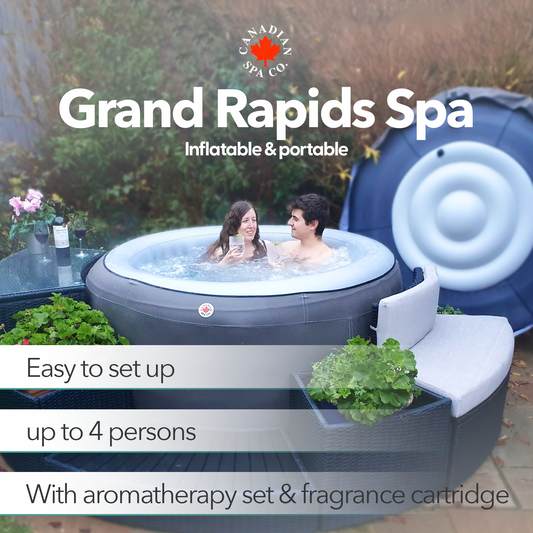
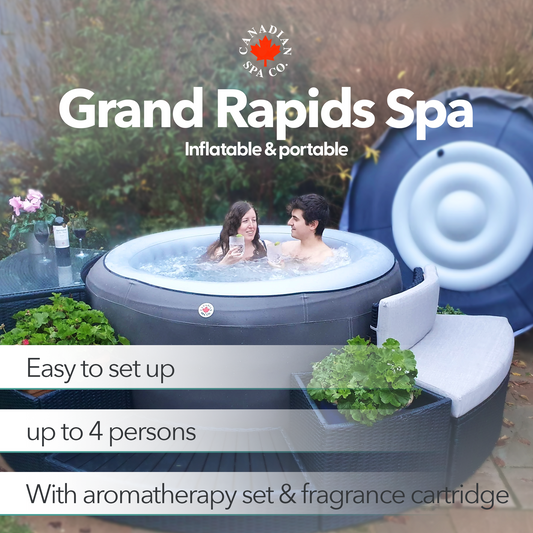
Grand Rapids Hot Tub – 2025 Stock | Limited Availability
Regular price £349.00Regular price£499.00Sale price £349.00Reduced -
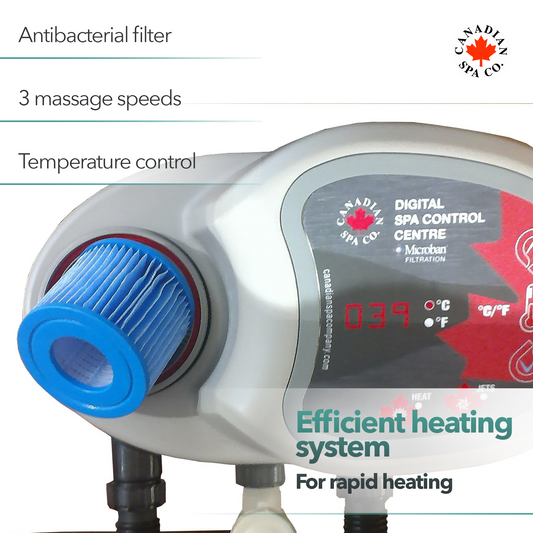
2026 Grand Rapids Inflatable - 110-Jet - 3 Speed - 4-Person Hot Tub with LED Light
Regular price £499.00Regular price

Inflatable Hot Tubs: UK Buying Guide
This collection is part of the Canadian Spa Company UK range of hot tubs, swim spas, saunas and spa essentials. Compare options by fit for your space, running costs, insulation, warranty and ongoing maintenance requirements to make a better long-term choice.
If you need help choosing the right model or part, our support team can guide you on compatibility, delivery and aftercare.
Who it's for
Where an inflatable is the right answer
An inflatable hot tub is not a compromised hard-shell — it's a different product for different buyers. Here's where it's genuinely the better pick.
-
The lowest-risk way to try the category
A hard-shell hot tub is a patio build, a dedicated circuit and several thousand pounds. An inflatable is a few hundred pounds and a Saturday afternoon. If you suspect you'll love a hot tub but aren't sure the routine sticks, start here — and upgrade with your eyes open if it does.
-
The obvious answer if you rent
You can't dig a foundation or run a 32A supply in a rented garden. You can fill, use and drain an inflatable. It's the only credible hot tub for a tenancy, and it goes with you when you move.
-
Run it year-round — or pack it away
Unlike most of the inflatable market, ours are properly insulated enough to sit on your patio through a British winter and keep giving you Friday-evening soaks in January. If you'd rather run it seasonally — a wedding, a rental property, a project — the tub also folds back into its bag and the footprint disappears. Optional, not the default.
-
74cm deep — neck-and-shoulders in
A lot of the inflatable category lets you sit in warm water up to your chest at best. Ours are built 74cm deep so you can actually sink down and submerge your neck and shoulders — the depth people associate with a 'proper' soak. It's also quietly why the tub holds heat better: a deeper, narrower column of water has less exposed surface area for each litre inside, so less heat escapes through the top.
-
Bubble massage — not jet therapy
Inflatables use an air-bubble system rather than pressurised water jets. The sensation is gentler, quieter and less targeted — pleasant for soaking and conversation, much less so if you're buying a hot tub specifically for directional back massage or hydrotherapy. If jet therapy is the actual reason you want a hot tub, a hard-shell spa is the right category.
-
Family-sized, not party-sized — on purpose
Our current inflatable, the Grand Rapids, is sized for 2 adults and 2 young children. We've deliberately stayed at a family footprint rather than chasing the 4-, 5-, 6-person tubs common at the high-street end of the market. The reason is honest: the larger a tub gets, the more exposed surface area it has, and the harder the heater has to work to hold temperature. Most 6-person inflatables cost a small fortune to run because they're bleeding heat out of a swimming-pool-sized lid. A tub built for 2+2 with a real vinyl wrap and 74cm depth keeps the running cost sensible and the water at the temperature you set it to.
Common questions
Inflatable hot tub FAQ
Can I use a Canadian Spa inflatable hot tub in UK winter?
Yes — and that's one of the reasons customers choose ours over a high-street inflatable. Our tubs are built with a genuine vinyl insulation layer wrapped around the body (not a printed two-tone panel mimicking one) and a 74cm internal depth, which reduces the surface-area-to-water ratio and cuts heat loss through the top. The practical effect: the tub holds 38–40°C through a British winter without the heater being permanently maxed out.
Honest context on running cost: a foamed acrylic hard-shell is still more efficient in deep cold — that's just physics, with 5″ tapered covers and full-foam cabinets doing work an inflatable can't match. But compared to the rest of the inflatable category, ours are a different class of winter tub. Plenty of our customers use them year-round, exactly as intended.
How much does an inflatable hot tub cost to run?
Broadly expect £3–£5 per day in spring, summer and autumn on our Grand Rapids inflatable (sized for 2 adults + 2 children), rising in the coldest weeks of December and January. Exact figures depend on your electricity tariff, how often the cover's off, and how hot you run it. Two things work in your favour: the real vinyl insulation wrap and the 74cm depth (less surface area per litre) — and the sensible footprint itself. Most 4-, 5- and 6-person tubs you'll find at the high-street end of the market have such a large surface area exposed through the top that they cost a small fortune to heat and hold. A family-sized tub with a real lid is the more efficient choice by a meaningful margin.
Benchmark against a well-insulated foamed acrylic hard-shell: that runs around £2–£2.50 per day year-round. If you already know you'll use a hot tub every week through a decade of British winters, the hard-shell maths wins on electricity alone over time — see our hot tubs collection. If you want something more flexible or you're sizing up the category for the first time, an inflatable is a genuine answer, not a compromise.
How long does it take to heat up?
From a cold fill (mains-temperature water, around 10–14°C) to a usable 38°C, plan on 18–24 hours on most inflatables, longer in winter. This is physics, not a fault — the heater is raising close to two tonnes of water from cold, and it'll draw near the full 13A doing it (which is why the socket needs to be a healthy one — see the electrical FAQ). Once at temperature, the tub cycles to hold the set point automatically. The lesson: fill it the day before you want to use it, not the morning of.
How long does an inflatable hot tub last?
Realistically, 3–5 years on a cared-for tub, with plenty of customers getting longer. Basic care is the main variable: keep the cover strapped on when it's not in use, keep pointy garden furniture and dogs' claws away from the walls, and don't let the water freeze if you ever do drain and leave it. The vinyl wrap on our tubs stands up to UK weather better than the printed-panel construction you'll find at the high-street end of the market, which is part of why the year-round use case actually works.
What surface can I put it on?
A filled Grand Rapids inflatable weighs about two tonnes with water and occupants — it needs a genuinely load-bearing base, not just somewhere flat. The non-negotiables:
- An existing level patio. Concrete, smooth close-jointed paving slabs, or a purpose-built hot-tub base pad are all fine.
- Not directly on grass. The tub sinks unevenly, the base fabric tears on stones, and the whole thing becomes a maintenance problem inside a month.
- Decking is fine — if it can take the load. Rule of thumb: if you'd be comfortable standing 15–20 grown men in the same footprint on that deck, it'll take the spa. Most domestic decking was not built with that in mind; if in doubt, ask the person who built it, or put the tub on the patio instead.
A foam ground sheet or base mat under the tub is strongly recommended on any surface — it protects the bottom fabric, adds a little insulation against cold ground, and evens out minor imperfections.
Do I need an electrician?
No dedicated spa circuit is required — our inflatables run from a standard outdoor-rated UK socket. One important caveat: the socket and its circuit need to be able to deliver the full 13A. The tub will draw close to the full 13A when it's heating, and under-powering it (a tired garage ring main, a weak spur, a borderline extension) means slow heat-up, nuisance RCD trips and a tub that never quite holds temperature. A healthy outdoor 13A socket on an RCD-protected circuit is fine; a patched-together supply is not.
What you absolutely should not do is run the tub from an indoor extension lead trailed through a window, or an indoor-only socket on the wrong side of the wall — that's how fires and trip problems happen. If you don't have a proper outdoor socket within cable reach, getting one installed is a short job for an electrician and well worth doing before the tub arrives.
What chemicals do I need?
Same basic water care as a hard-shell spa: a sanitiser (chlorine or bromine — start with one and stick with it), a pH tester and pH-adjusting agents (pH+ / pH−), and a shock-dose sanitiser for after heavy use. We sell the full starter pack under essential chemicals, and our water-care guide in the journal walks through the routine. The chemistry is straightforward; the discipline of testing a couple of times a week is what keeps the water clear.
How often do I need to change the filter?
Rinse the cartridge filter under a tap every 3–5 days of regular use, and replace it every 4–6 weeks — or sooner if it's visibly discoloured or waterflow has dropped. Running with a clogged filter is the single most common cause of 'cloudy water' and 'the heater seems weak' on inflatable tubs. Filter stock for our inflatable range sits in filters.
How often do I change the water?
Every 4–6 weeks with normal use and sensible chemistry — the same interval as a hard-shell spa. Heavier use shortens it; a single user with a tidy routine can stretch it. If the water is going cloudy or the chemistry is becoming hard to balance before 4 weeks are up, the filter is usually the cause rather than needing a full drain and refill.
Does an inflatable hot tub have massage jets?
Not in the sense a hard-shell spa does. Inflatables use an air-bubble system — a pump forces air through small holes around the inside of the tub, creating a fizzy, all-over bubble effect. It's pleasant, but it's not pressurised water jets aimed at your back, neck and shoulders. If the main reason you want a hot tub is targeted hydrotherapy for muscle tension, low back pain or joint stiffness, a hard-shell with directional jets is the category you actually want. Our hot tubs collection has the full jet-equipped range.
How many people fit, and how deep is the water?
Our current inflatable, the Grand Rapids, is sized for 2 adults and 2 young children — a family tub, not a party tub. Water depth is 74cm, which is deeper than most high-street inflatables and enough to actually submerge neck and shoulders rather than just sit chest-deep.
We've deliberately stayed at this size rather than listing 4-, 5- or 6-person bubble tubs. A larger tub sounds generous on a product page but — especially at the inflatable end of the market, where walls and covers are thin — a much bigger surface area means a much bigger heat-loss problem. Six-person inflatables routinely run at two or three times the daily cost of a family-sized one, for water most households use four-up maybe twice a year. If you genuinely want a tub for 4+ adults regularly, a hard-shell acrylic spa is the honest recommendation — see our hot tubs collection.
How quickly can you deliver?
Please allow up to 10 working days as a ceiling, though most in-stock inflatables land a fair bit sooner from our Redhill, Surrey warehouse. Exact despatch timing is on each product listing. Inflatables are a lot less demanding on delivery than a hard-shell spa — no crane, no kerbside pallet handler, no two-person lift. The driver brings a wheeled carton to your front door.
What's the warranty?
Inflatable hot tubs carry a 12-month manufacturer warranty on the heater/pump control unit and the liner against manufacturing defects. Wear items (filter cartridges, inflation valves, cover straps) are consumable and not covered — that's standard across the category. Full terms on each product listing.
Are pets and children safe around it?
The tub is sturdier than it looks, but the walls and floor are fabric-reinforced PVC, not acrylic. A dog with claws, a cat that decides the cover is a sunlounger, a rose cane blown against the liner in a gale — any of those can cause a puncture. Children should be supervised around a filled tub in exactly the same way they would be around any other body of water: an inflatable hot tub can be deep enough to drown in. Keep the inflatable cover on and strapped down when the tub is not in active use, and have a responsible adult present whenever anyone is in the water.
UK buying guide
Inflatable hot tubs UK — buying guide
An inflatable hot tub is the quickest, cheapest way into the category — and for plenty of buyers, it's the right way in, not a compromise. The honest buying question is matching the tub to how you'll actually use it. This guide walks through the things worth thinking about before you hit order.
Canadian Spa vs the high-street end of the market
Most of what's marketed as an inflatable hot tub on the UK high street is a bubble-walled paddling pool with a heater bolted on. That works — up to a point — but the category limits people write about (can't hold heat in winter, shallow soak, short lifespan) are largely limits of that specification, not the category itself.
What the Canadian Spa inflatables do differently:
- A real vinyl insulation layer wrapped around the body — not a two-tone plastic panel printed to look insulated. You can feel the difference on a December evening.
- 74cm of depth. Enough to actually submerge neck and shoulders (most bubble tubs only get you chest-deep), and less exposed water surface per litre inside — so less heat loss through the top.
- A cartridge filtration cycle, chlorine/bromine dosing and water-care logic that matches how a hard-shell spa is run.
- UK stock, UK support, and a 12-month manufacturer warranty handled from Redhill, Surrey — not an email address that goes to a reseller you've never heard of.
Why we sell a 2+2 family tub, not a 6-person one
A lot of the inflatable category competes on seat count — "six-person hot tub!" on the box — and the running-cost bill lands a month later. The physics are straightforward: the bigger the tub, the more surface area across the top for heat to escape through. Inflatable lids and walls are thin compared to a foamed acrylic spa, so that exposed area loses heat fast; the heater then has to fight the cold continuously just to hold 38°C.
Our current inflatable, the Grand Rapids, is sized for 2 adults and 2 young children — a deliberate decision. A family-footprint tub with a real vinyl wrap and 74cm depth holds temperature cleanly and runs on a sensible electricity bill. If you genuinely need a tub for 4+ adults regularly, the honest answer isn't a bigger inflatable; it's a hard-shell acrylic spa, where the insulation package is designed to carry that surface area. We'd rather point you there than sell you a tub that hurts to run.
Inflatable vs hard-shell — which one are you actually shopping for?
Some useful rules of thumb:
- Inflatable is the right answer if: you rent and can't commission a bespoke spa platform; you want the option to pack it away later; you're testing whether a hot tub routine suits your life; your budget is under £1,500 and you'd rather own a real tub than finance a hard-shell; or a jet-therapy massage is not the main reason you want a tub. Year-round use is on the table too, thanks to the insulation and depth.
- A hard-shell is the right answer if: jet-therapy hydrotherapy for muscles, back or joints is the main reason you're buying; you want the tub to last 10+ years and be a patio fixture; you want the absolute lowest year-round running cost; or multiple adults will use it several times a week across a full decade.
There is no hierarchy here — the two categories solve different problems. We sell both. We're happy to tell you when an inflatable is the better choice, and equally happy to tell you when it isn't.
Realistic running costs at current UK tariffs
Hot tub running cost advice on the internet is mostly out of date — most of it was written when UK electricity was half what it is now. Today's honest figures for a Canadian Spa inflatable at 38°C:
- Spring, summer, early autumn: around £3–£5 per day on our Grand Rapids (2 adults + 2 children), based on customer feedback. Warmer months at the low end.
- Winter: rises during the coldest weeks of December and January, but the vinyl insulation wrap and 74cm depth keep it meaningfully below what a bubble-walled competitor tub consumes at the same set point. Year-round averages depend on how cold a winter you get and how often you're in the tub.
- Hard-shell acrylic spa, year-round: around £2–£2.50 per day at current tariffs. The foamed cabinet and 5″ tapered cover are engineered to be the most efficient answer over a full year of continuous use.
These are ranges, not guarantees — specific consumption depends on ambient temperature, how often the cover's off, how hot you run it, and your electricity unit rate. But they're the ranges we hear back from real customers, not optimistic lab numbers.
The base you put it on matters more than the tub
Filled with water and people, the Grand Rapids inflatable weighs about two tonnes. That needs a proper base — not just somewhere flat. Work from these rules:
- An existing level, load-bearing patio. Concrete, smooth close-jointed paving slabs, or a purpose-built hot-tub base pad all qualify. The tub is not going on grass directly — it'll sink, the base fabric tears on stones, and water pools around the feet.
- Decking, only if the structure is genuinely strong enough. Useful rule of thumb: if you'd be comfortable seeing 15–20 grown men standing in the same patch of your deck at once, it can take the spa. If the answer is "probably not," put the tub on the patio instead, or have the decking reinforced before delivery. Most domestic garden decking wasn't built with hot-tub loads in mind.
- Level matters. An inflatable tub on a slope fills unevenly, stresses one side of the liner, and looks wrong even when it's working. Spirit-level the base before you fill.
- A foam ground sheet under the tub is strongly recommended — it protects the bottom fabric, adds a little insulation against cold ground, and smooths out minor surface imperfections. We include a ground mat with most of our inflatables; if yours doesn't, buy one.
Power — you need the full 13A, not a borderline supply
Our inflatables run from a standard outdoor-rated UK 13A socket on an RCD-protected circuit. The important caveat is that the socket genuinely needs to be able to deliver the full 13A. When the tub is heating — especially on a fresh fill or a cold morning — it draws close to the full 13A to get the water up to temperature quickly. An under-specified supply (an over-loaded ring main already feeding half the garage, a weak spur, a long indoor extension lead trailed out a window) means a slow or stalled heat-up, nuisance RCD trips, and a tub that never holds its set point.
The right answer is an outdoor-rated 13A socket on a healthy circuit — installed by an electrician if you don't already have one within cable reach. It's a short job and well worth doing before the tub arrives. What you must not do is try to make the install work with indoor extension leads trailed through windows, daisy-chained power strips, or an indoor-only socket on the wrong side of the wall — that's how fires start, RCDs nuisance-trip in the rain, and manufacturer warranties get voided.
Water care: the discipline, not the chemicals
An inflatable needs the same basic water chemistry as any other hot tub — a sanitiser (chlorine or bromine), pH in a narrow band, and a shock dose after heavy use. The chemicals are cheap and straightforward. What keeps the water clear is the discipline: test a couple of times a week with a strip, rinse the filter every few days, replace the filter every 4–6 weeks, and change the water every 4–6 weeks. Skip any of those and the tub goes cloudy, then problematic, then has to be drained anyway. A tidy routine saves more chemicals than any specific product choice.
Winter — a year-round spa, not a fair-weather one
Unlike the high-street bubble-tub category, our inflatables are built to sit on your patio through a British winter and keep giving you Friday-evening soaks in January. The combination of the vinyl body wrap and the 74cm depth is what makes that realistic — the tub holds 38–40°C without the heater permanently pinned at max.
Two viable approaches, depending on how you want to use it:
- Run it year-round (the design intent). Cover strapped on when you're not using it, heater active, chemistry kept up. Expect a higher electricity bill in the coldest weeks than in summer — that's physics — but materially lower than a competitor inflatable at the same set point.
- Run it seasonally, pack it away in winter. Optional, not required. Drain, clean and dry the tub, fold it back into its bag and store somewhere dry and rodent-free. Handy if you're going away for a full winter, don't want the tub on the patio when it's not in use, or are running it at a rental property.
The one thing to avoid: leaving the tub full of water but switched off during a hard freeze. A frozen heater or pump is a write-off, not a warranty claim. If you're going away for a fortnight in January, either keep the tub running normally with the cover on, or drain it before you go.
Where Canadian Spa fits
Our inflatable range is held in our UK warehouse, supported from our UK showroom and backed by a UK-based customer service team — so if something goes wrong in week 3 of owning it, you're phoning Redhill, Surrey, not emailing a reseller in Shenzhen. We've been trading as a hot tub specialist in the UK for over 35 years, and the same UK-first support ethos that runs our acrylic and swim spa ranges runs the inflatables — they're not a bolt-on from a third-party brand, they're a Canadian Spa product.
Frequently asked
What's the best inflatable hot tub UK?
The best inflatable for you is the one that matches your realistic use. For a family (2 adults and 2 young kids), our Grand Rapids is the straight answer — real vinyl insulation wrap, 74cm depth, cartridge filtration, strapped cover, supplied ground mat, UK warranty and UK support. If you genuinely need a tub for four-plus adults sitting in it regularly, don't chase a 6-person inflatable — the surface-area-to-heat-loss ratio makes them painfully expensive to run, and a hard-shell acrylic spa is the honest recommendation instead. See our hot tubs collection.
Are inflatable hot tubs worth it?
If you'll use it regularly — yes, very likely. The entry price is a fraction of a hard-shell and the setup is an afternoon. Ours are specifically built to work year-round (vinyl insulation wrap plus 74cm depth) rather than pack away at the end of summer, so you're not losing half the year to the weather the way you might with a bubble-walled competitor. The hard-shell maths wins on pure electricity cost over a decade of heavy year-round use; the inflatable wins on upfront price, flexibility and how fast you can be sitting in it.
Inflatable hot tub vs hard-shell — which is right for me?
Renter, entry-level, budget under £1,500, no jet-therapy requirement, or want the option to pack the tub away → inflatable. Jet hydrotherapy is the main reason you're buying, you want a 10+ year patio fixture, or you'll use it several times a week for a decade and want the lowest possible running cost over that period → hard-shell. Winter alone isn't the deciding factor any more on ours — both categories can hold temperature through a British winter; the hard-shell just does it more efficiently.
Will a Canadian Spa inflatable hold temperature through January?
Yes, in normal British winter conditions. The vinyl insulation wrap and 74cm depth are the difference between a tub that holds 38°C through a frost and one that chases the set point all night. As long as the tub is running — cover on when not in use, heater active — the water stays at temperature. The real risk in winter is leaving the tub full but switched off during a hard freeze; that's when a frozen heater or pump becomes a write-off. If you're going away for a fortnight in January, either keep the tub running normally with the cover on, or drain it cleanly before you leave.
How fast can you deliver an inflatable hot tub in the UK?
Allow up to 10 working days as a realistic ceiling — most in-stock inflatables land well inside that from our Redhill warehouse. Exact timing is shown on each product listing. Inflatables are parcel-delivery friendly (wheeled carton to the front door, no pallet handler required), so they move faster than a hard-shell spa.