Hot tubs · Patio spas
The bridge between inflatable and acrylic. Core hot tub, none of the frill.
Patio spas are the category we built for buyers who want a proper insulated hot tub — not an inflatable that bleeds heat all winter — but aren't ready to spend £6,000+ on a full acrylic spec with Bluetooth, waterfalls and perimeter LEDs. The deal is honest: we strip the features that don't touch the water, keep the ones that do, and hand you back a tub that costs meaningfully less to buy and about £2/day less to run than an inflatable.
Napkin math: a £600 inflatable and a £3,000 patio spa look £2,400 apart on day one. At £2/day (≈£730/year) of running-cost savings, the patio spa is level on total cost around 3.3 years in — and substantially ahead forever after that. That's the argument. Everything on this page is built around it.
Four reasons the patio spa exists as its own category
The patio-spa range isn't a lite acrylic and isn't a dressed-up inflatable — it's a deliberately engineered middle tier. Here's the honest case for why it's in the range at all, and where it's the right answer.
-
The gap product — built for it, not compromised into it
Inflatables live at the bottom of the market on price but lose on insulation, cover, jets and longevity. Full-spec acrylic hot tubs live at the top on features but ask for £6,000–£10,000 before you see a drop of water. The patio spa is an engineered middle — the same vacuum-formed acrylic shell as our mainline tubs, high-density closed-cell foam with IR-reflective panels to trap heat, a Balboa-grade control pack, a real tapered cover, and a deep enough shell for actual hydrotherapy. It isn't an inflatable dressed up; it isn't an acrylic with bits missing. It's the same base build as a mainline spa with the non-water-touching frills stripped — the tub we'd build if someone asked for £3k of honest spa and no marketing.
-
About £2/day cheaper to run than an inflatable
Inflatables bleed heat. Thin PVC walls, a 1-inch insulated top that deflates every time someone gets in, a pump that runs flat-out because the insulation can't hold temperature. Typical UK running cost: £3.50–£4.50/day year-round. A patio spa — vacuum-formed acrylic shell, high-density closed-cell foam insulation with IR-reflective panels, 3″-tapering-to-2″ hard cover — comes in around £1.50–£2/day. That's a £700+/year gap. On a £600 inflatable vs a £3,000 patio spa, the £2,400 price difference pays back in roughly 3.3 years of running-cost savings alone (£2/day × 365 ≈ £730/year). Past that, the patio spa is pure gain — and still going strong at year 10, when the inflatable is typically on its third.
-
Stripped, not cheapened — what's gone and what stayed
Hitting a patio-spa price point means taking something out. We took out the features that don't touch the water: no Bluetooth speaker, no waterfalls, no perimeter cabinet lights. The parts that matter to the actual soaking experience all stayed: the same vacuum-formed acrylic shell as our mainline tubs, Balboa-grade control pack, 14–18 stainless jets, high-density closed-cell foam with IR-reflective heat-trap panels, proper tapered hard cover, and a large underwater LED so you're not soaking in pitch black once the sun's down. The underwater light in particular is the one feature we wouldn't remove — ambient light in the water is worth more than a second speaker you can't hear over the jets anyway.
-
Holiday let and Airbnb favourite — for a specific reason
The biggest single buying cluster for patio spas in our order book is holiday lets and short-term rentals. The reason isn't the price tag — it's feature exposure. Every Bluetooth speaker, waterfall pump and strip of perimeter LED on a let property is a thing that can break mid-booking, generate a 'the hot tub isn't working' complaint, and turn into a refund request or a bad review. Patio spas have fewer electromechanical features, so fewer fault vectors — the tub either holds 38°C with jets working, or it doesn't. Less to go wrong, less guest compensation, cleaner reviews.
-
Ex-Display/Demo Manitoba 4-Person Patio Spa | 172 x 154 cm
Regular price £3,995.00Regular price£4,995.00Sale price £3,995.00Reduced -
Okanagan 4-Person Patio Spa | 160 cm Diameter
Regular price £2,932.99Regular price£4,999.00Sale price £2,932.99Reduced -
Muskoka Patio Spa | 5-Person 14-Jet | 188 x 188 cm
Regular price £3,733.99Regular price£5,999.00Sale price £3,733.99Reduced -
Manitoba Patio Spa | 4-Person 14-Jet | 172 x 154 cm
Regular price £4,999.00Regular price£6,999.00Sale price £4,999.00Reduced -
Cornwall Plug & Play Hot Tub | 5-Person 18-Jet 1980x1980x730mm
Regular price £4,999.00Regular price£5,999.00Sale price £4,999.00Reduced


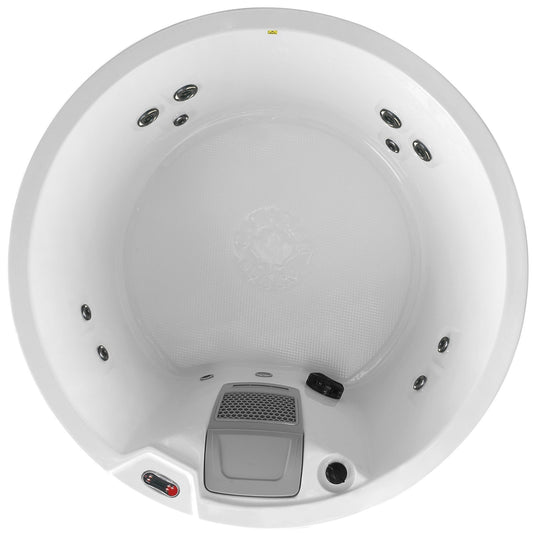


About Patio Spas
If an inflatable feels too compromised but the flagship acrylic line is more spa than your space or budget needs, the patio range is what fills the gap. Same proper acrylic shell, same Mountain Pure™ UV-C plus ozone water care, same Balboa control system as the acrylic line — but without the headline insulation and finish work that pushes the bigger models into a different price bracket.
Cover thickness here is 3″→2″ rather than the 5″→3″ on the main acrylic range, which means slightly higher running costs in winter but a noticeably lighter cover to lift twice a day. Cabinet is composite in a single fixed finish — black cabinet, plain white shell, black cover across the whole range, no marbling and no shell colour options. The trade-off is deliberate: the cost savings show up in the price tag, not in shortcuts on the things that matter for water reliability.
Twelve months of warranty cover on parts, labour and shell included. Compare the seating layouts and jet counts, below.
Who actually buys patio spas
Six routes to the patio spa category
The patio-spa buyer isn't one archetype — but the buying patterns cluster around six specific use cases. If one of these sounds like you, the category is probably right.
-
"Third inflatable in five years — I'm done"
This is the most common upgrade path we see. You bought a Lay-Z Spa for a summer, loved it, replaced it eighteen months later when the pump died, replaced it again after the liner split, and are now staring at the electricity bill wondering whether this is a long-term answer or a recurring mistake. The patio spa resolves that: a single £3,000–£4,000 purchase that runs at less than half the daily cost, lasts a decade, and uses the same 13A outdoor socket as the inflatable. On day 1,200, you've spent less in total, and you've got a real hot tub rather than a disposable one.
-
Holiday let owners and Airbnb hosts
The patio spa's low-feature profile is the feature for rental operators. Guests can't complain that the Bluetooth isn't connecting because there isn't one. The waterfall can't jam with lime scale because there isn't one. Perimeter LEDs can't short on a dropped wine glass because they aren't there. What's left — water that heats, jets that jet, a cover that insulates — is exactly what a guest rates a tub on. Our holiday-let operators consistently report fewer mid-stay service calls on patio spas vs fully-featured acrylic spas. That translates to fewer compensation payouts, fewer 3-star reviews about 'the hot tub had issues', and materially lower annual downtime cost.
-
First-time spa buyers unsure about the jump
If you've never owned a proper hot tub, £6,000+ is a lot of money to commit to a product whose day-to-day ownership experience you've never really tried. A patio spa is the honest first step: most of the ownership experience of a full acrylic tub (water, heat, jets, cover) at roughly half the spend. If after two or three years you want the full acrylic spec — loungers, captain's chairs, waterfalls, Bluetooth, the lot — you've got real data on what you actually value. If you decide patio was enough tub for you, you haven't over-bought.
-
Tight access, small gardens, second properties
Patio spas are physically smaller than full acrylic tubs — 160–198cm square or circular versus the 215cm+ footprint of most acrylic models. That matters for three kinds of buyer: tight garden access where a 220cm-wide shell won't fit through the side passage, small patios where the larger spa would dominate the space, and second properties (garden studios, holiday-home annexes, rural retreats) where the spa is a secondary amenity rather than a primary feature. The Okanagan in particular — 160cm diameter circular — tucks into corners an acrylic tub simply can't.
-
Budget-conscious buyers who won't compromise on insulation
The specific buyer the patio spa is designed for: someone who's done the homework, knows that inflatables are a running-cost trap, knows that a poorly-insulated cheap acrylic is worse than a well-insulated patio spa, and wants proper thermal spec at a realistic price. Patio spas carry the same high-density closed-cell foam and silver IR-reflective heat-trap panels as the rest of our range. The cover is thinner (3″→2″ vs 5″→3″ on acrylic) because the shell is smaller and holds less water; thermal performance is balanced for the category, not cheaped-out.
-
Secondary or overflow tubs at existing properties
Some of our patio-spa sales are genuinely additive rather than first-tub buys — a garden-studio cabin that gets its own smaller tub, a granny-flat annexe, a poolside plunge alongside an existing acrylic main spa, or a second house where a full acrylic install would be overkill. The 13A plug-and-play electrical spec means no second consumer-unit upgrade at a property that already has one acrylic tub running on 32A. Set it down, plug it in, fill it, run it.
Common questions
Patio spa FAQ
Patio spa vs inflatable — is it really worth the extra money?
Honest answer: yes, if you're planning to own a hot tub for more than three years. The inflatable wins on day-one price — typical £400–£700 vs £3,000–£5,000 for a patio spa. It loses on running cost (£3.50–£4.50/day vs £1.50–£2/day), on longevity (two to three years typical vs ten-plus), on jets and seat comfort, and on warranty coverage. Napkin math: a £2,400 price gap at ~£730/year of running-cost savings (≈£2/day) pays back in roughly 3.3 years. Past year five, the cumulative cost-of-ownership gap is several thousand pounds in the patio spa's favour. The only case where the inflatable is genuinely the right answer is if you're certain you want a hot tub for one or two summers only.
Patio spa vs acrylic — what am I actually giving up?
Four things, mostly non-thermal:
- Features that don't touch the water. No Bluetooth speaker, no waterfall, no perimeter cabinet LEDs. The underwater LED stays.
- Seat variety. Patio spas are benches; no dedicated loungers or captain's chairs. For long hydrotherapy sessions cycling between seat types, a full acrylic is the answer.
- Cover thickness. Patio spa cover tapers 3″→2″ vs acrylic 5″→3″; right-sized for the smaller water volume but not the same raw spec.
- Warranty. 12 months on patio spas vs 2 years on acrylic.
Things that do not change: the same vacuum-formed acrylic shell as our mainline tubs, high-density closed-cell foam with IR-reflective heat-trap panels, the Balboa-grade control pack, proper stainless jets, 13A plug-and-play electrics (on most patio models), and build quality. We strip the features; we don't cheapen the build.
Why only 12 months warranty on a patio spa vs 2 years on acrylic?
It's a price-point calculation, not a confidence one. The 2-year acrylic warranty is priced into those tubs; the 12-month patio-spa warranty is part of how we hit the £3,000–£5,000 RRPs. Patio spas are built to the same engineering standards as the acrylic range — same Balboa control, same jet plumbing, same insulation — but carry the shorter warranty because the whole product is positioned as a lower-commitment purchase. Our Extended Warranty (from £500) is available on patio spas exactly as on acrylic if you'd rather extend the cover; it usually starts earning its value in years 3–6 on any spa category.
The cover is only 3″ tapering to 2″ — is that enough?
For the water volume a patio spa holds, yes. Acrylic tubs carry a 5″→3″ tapered cover because they're holding 1,400–1,900 litres and the cover-surface heat-loss is a meaningful line item. A patio spa typically holds 800–1,300 litres — the cover surface is smaller and the water mass is smaller, so the insulation requirement scales down with it. Our patio-spa covers still carry the core features that matter: tapered shape to shed water (pooling water rots covers fastest), snow-load rating for UK winters, IR-reflective underside. Thinner, not worse — right-sized.
What features are specifically missing from a patio spa vs acrylic?
The deliberate removals, in order of how often buyers ask about them:
- Bluetooth speaker system — no onboard audio. Bring a portable speaker if you want music.
- Waterfall feature — no cascade. Jets and bubbles only.
- Perimeter cabinet LEDs — no side/corner mood lighting on the cabinet exterior. The underwater LED stays.
- Dedicated lounger seats — bench seating only. No full-horizontal lounger.
- Control-panel app connectivity — no phone-app remote control on most models. Physical control panel only.
- Headrest cushions on every seat — simpler seating profile.
The removals cluster around 'features that can break mid-ownership'. Each one is a potential service call, a potential warranty claim, and — on a holiday let — a potential guest complaint. Stripping them is a deliberate reliability move, not a cost-cutting one.
What's kept on a patio spa that matters?
Everything that touches the soaking experience:
- Same vacuum-formed acrylic shell as our mainline tubs — the patio spa is built on the same base, not a cheaper substrate.
- High-density closed-cell foam with silver IR-reflective heat-trap panels — the thermal spec that keeps running cost at £1.50–£2/day.
- Balboa-grade control pack — same electronics family as the full acrylic range, with GFCI, temperature control, filtration programming.
- Stainless steel jets — 14 jets on the Manitoba and Muskoka, 18 on the Cornwall AI. Real hydrotherapy, not a bubble fountain.
- Tapered hard cover — a proper insulating cover, not the inflatable '1-inch pad' cover.
- Large underwater LED light — so evening use isn't a pitch-black soak. This is the one 'ambience' feature we wouldn't remove from any tub at any price.
- 13A plug-and-play electrics on the core range — no electrician, no 32A install.
How fast does a patio spa heat up?
Faster than a full acrylic tub, because there's less water to heat. From a cold mains fill (10–14°C) up to 38°C typically takes 8–14 hours on 13A — roughly a third less than a 5/6-seat acrylic. That matters most between water changes: a full drain-and-refill every 8–12 weeks is a routine job rather than a two-day planning exercise. For holiday-let operators between guest bookings, the faster recovery time is directly useful; you can drain/refill between guests on a same-day-turnover schedule where a full acrylic wouldn't fit the window.
What's the actual running cost of a patio spa UK?
Our published year-round figure for patio spas is £1.50–£2/day at current UK electricity tariffs. That assumes 38°C set point, UK weather, daily cover-off use of 30–45 minutes, the closed-cell foam and IR-reflective heat-trap panels functioning as designed, and a cover that's still in good condition. Patio spas sit toward the cheap end of that band because the smaller water volume means smaller steady-state heat loss. For context: our full acrylic range runs £2–£2.50/day; plug-and-play 13A tubs sit in similar territory to patio spas; inflatables run £3.50–£4.50/day.
Do patio spas run on a 13A plug?
Most of them, yes — the Okanagan, Manitoba and Muskoka all run on a standard 13A outdoor socket. The Cornwall AI (5-person, 18-jet, 70-nozzle spec) is convertible: runs 13A out of the box, can be rewired to 32A hardwired if you'd rather the faster heat-up and higher jet concurrency that the bigger spec enables. Check the individual product listing for the electrical spec before ordering. For the 'no electrician, no install drama' buyer, the 13A patio spas are the category to focus on — plug into any properly-rated outdoor socket and fill.
Are patio spas good for Airbnb or holiday lets specifically?
In our experience, yes — they're the category most of our let-operator customers converge on after their second spa purchase. Three specific reasons:
- Lower feature exposure. Fewer electromechanical features means fewer components that can fail mid-booking. A guest reports 'the Bluetooth doesn't work' as a compensation claim; they can't report a Bluetooth they don't know was ever there.
- Faster turnover. Smaller water volume, faster drain-refill-reheat cycle between bookings. Easier to slot a water change into a same-day changeover.
- Lower running cost at steady state. On a property that might have guests two weeks out of four, the empty-but-warm weeks are cheaper to cover.
Commercial-grade considerations (separate filtration, formal log-keeping for H&S) aren't something any domestic spa covers — if your property is a pure commercial asset, talk to a commercial spa supplier. For owner-hosted small lets, the patio spa is frequently the right answer.
Can I upgrade from a patio spa to an acrylic later?
Absolutely — and a meaningful share of our acrylic buyers started on a patio spa. The patio spa isn't 'locked in'; once you've lived with the category for a few years and know what you actually value about ownership, moving up to a full acrylic is a clean transaction. Used patio spas in good condition have a real resale market (the low-complexity features that make them good holiday-let tubs also make them easy second-hand sales). If you're buying a patio spa now partly to test whether ownership suits you, that's a rational approach, not a mistake — the depreciation on three years of patio-spa ownership is typically lower than three years of inflatable replacement cycles.
What's involved in delivery and setup?
Kerbside delivery included; back-garden positioning is available as an add-on (see the Back Garden Upgrade Bundle). Patio spas are lighter and narrower than acrylic tubs, which usually means garden-gate access isn't the problem it can be with a 220cm+ acrylic shell — most standard side passages fit the 160–200cm patio-spa width. Setup is owner-doable on the 13A models: place on a level base (concrete slab or close-jointed paving, rated for the filled weight ~1,200–1,800kg), plug into the outdoor socket, fill with a hose, dose the starter chemistry and you're swimming that evening. No electrician required on the standard 13A range.
UK buying guide
Patio spas UK — the three-tier market explained
The UK hot-tub market breaks cleanly into three tiers once you look past the marketing. Understanding which tier fits your actual use is the single most useful decision a first-time buyer can make — it's worth more than any individual model comparison within a tier.
The three tiers, honestly
Tier 1: Inflatable (Lay-Z Spa and similar). £400–£700. Summer-weekend product. Thin PVC walls, inflatable-top cover that deflates every time someone gets in, underpowered pump, no real jets. Running cost £3.50–£4.50/day because insulation can't hold temperature. Lifespan 2–3 years before liner splits or pump fails. Right answer if you genuinely only want a tub for one or two summers and will store it in the shed the rest of the year.
Tier 2: Patio spa. £3,000–£5,000. Year-round product. Same vacuum-formed acrylic shell as the mainline acrylic tubs, high-density closed-cell foam with IR-reflective heat-trap panels, Balboa-grade control pack, stainless jets, tapered hard cover, underwater LED. Running cost £1.50–£2/day. Lifespan 10+ years with normal maintenance. Strips the non-water features — Bluetooth, waterfall, perimeter LEDs, full-length loungers — to hit the price point without cheapening the build. Right answer for most serious first-time buyers and most holiday-let operators.
Tier 3: Full acrylic. £6,000–£15,000+. Year-round flagship. Acrylic shell, seat variety including loungers and captain's chairs, Bluetooth audio, waterfall features, perimeter mood lighting, more jets, often 32A hardwired for bigger pump HP. Running cost £2–£2.50/day. Lifespan 15+ years with service. Right answer for buyers who want the full features package and have the budget to treat the spa as a multi-year commitment.
The patio spa is designed specifically for the gap between tier 1 and tier 3, where most serious domestic buyers actually land once they've done the homework.
The 3.3-year math, properly
Our headline number — 'patio spa pays back vs inflatable in 3.3 years' — deserves showing in detail so you can run it against your own assumptions. Two ways to slice it:
1. Napkin version (purchase gap only).
- Purchase gap: £3,000 − £600 = £2,400
- Running-cost savings: £2/day × 365 = £730/year
- Payback: £2,400 ÷ £730 = 3.3 years
2. Full total-of-ownership version (purchase + running cost).
- Inflatable total-of-ownership, year 1: £600 purchase + (£4/day × 365) = £600 + £1,460 = £2,060
- Patio spa total-of-ownership, year 1: £3,000 purchase + (£1.75/day × 365) = £3,000 + £639 = £3,639
- Annual delta from year 2 onward: £1,460 − £639 = £821/year in patio-spa's favour
- Day-1 gap: £3,639 − £2,060 = £1,579 inflatable ahead
- Payback on total-of-ownership basis: £1,579 ÷ £821 ≈ 1.9 years to even; by year 3, patio spa is roughly £63 ahead cumulatively, and growing ~£820/year thereafter
The 3.3-year headline is the cautious number — it only counts the daily-running-cost delta at £2/day flat. The total-of-ownership math (which credits the patio spa for its lower year-one running cost too) closes the gap faster. Either lens, the direction of travel is the same.
If you plug in a more conservative inflatable running cost (£3/day) and a pricier patio spa (£4,000), the payback stretches out closer to 4 years. If you run the inflatable harder (genuinely year-round), the payback shortens to 2 years. Either way, past year five, the cumulative cost-of-ownership gap is comfortably multiple thousands of pounds in the patio spa's favour. The inflatable's only win is if you know — genuinely know — you want a tub for fewer than three years.
What we stripped and why
Patio spas remove five things deliberately:
- Bluetooth audio. In-tub speakers sound mediocre, get overdriven by jet noise, and are a warranty-claim generator. A £50 portable Bluetooth speaker on the patio sounds better than any in-tub system at any price.
- Waterfall feature. Visually pretty in showroom photos. In practice, a small dedicated pump that scales in hard-water areas, clogs with hair, and adds a jet-plumbing failure mode we'd rather not introduce.
- Perimeter cabinet LEDs. The mood-lighting strips on acrylic tub cabinets are a good design feature when they work and a real service annoyance when a driver fails or a strip shorts on damp. The underwater LED does most of the ambience job on its own.
- Full-length lounger seat. Loungers are great, but they're the single most size-constrained feature in a hot tub — a 6-foot adult loungers well; a 5'5" adult floats up when the jets kick in; a 6'3" adult's feet hit the wall. Patio-spa bench seating is universally comfortable for any body type.
- App-controlled smart features. Phone-app temperature control is convenient; it's also an ongoing software dependency on a ten-year product. Physical control panels are reliable for fifteen years.
What we kept and why
Every design decision here was 'does it touch the water'. If yes, it stays:
- The same vacuum-formed acrylic shell as the mainline range. Same base build. The patio spa is the mainline spec with frills removed, not a cheaper substrate.
- High-density closed-cell foam + silver IR-reflective heat-trap panels. This is why running cost is £1.50–£2/day instead of £4/day. Non-negotiable.
- Balboa-grade control pack. Same electronics platform as the full acrylic range. GFCI, temperature stability, filtration programming, fault codes. Repairable, parts-available, supported.
- Stainless steel jets. 14 on the Manitoba and Muskoka, 18 on the Cornwall AI. Real hydrotherapy volume and pressure, not bubble-mat token jets.
- Tapered hard cover. 3″→2″ — right-sized for the smaller water volume. Snow-load rated. IR-reflective underside.
- Large underwater LED. The one ambient-feature we kept, and the one we'd never remove. Evening soaks in pitch black aren't a feature, they're a gap.
- 13A plug-and-play. Standard outdoor socket, no electrician, no 32A install. Core to the product's accessibility.
The holiday let case, in detail
If you're buying a patio spa for a let property, three things are worth knowing beyond the general buying guidance:
- Guest complaint vectors scale with feature count. On acrylic tubs with Bluetooth + waterfall + perimeter LEDs, we see roughly 3x the mid-booking service calls vs patio spas on equivalent rental volume. Most aren't 'spa broken' — they're 'Bluetooth won't pair' or 'LED strip flickering'. On patio spas those features don't exist, so they can't fail.
- Between-booking turnover. Water change cycle on a patio spa is 8–12 weeks vs similar for acrylic, but the actual drain-refill-reheat takes half the elapsed time because there's half the water. That's directly useful for same-day changeovers.
- Price-point matching the listing. A 'sleeps 4' let with a hot tub is a broadly expected spec; a 'sleeps 4' let with a fully-featured 6-seat acrylic tub is over-spec for the listing and the guest doesn't notice the upgrade. Patio spas match the listing tier, which keeps booking-economics honest.
When to size up to acrylic instead
There are situations where the full acrylic range is the right answer despite the extra spend. Honestly:
- Routine use is four or more adults together — patio spas are built around two to four adults, not five-plus. For regular group use, see the 5+ seat range.
- Long hydrotherapy sessions cycling between seat types matter (lounger for horizontal, captain's chair for vertical lumbar work, cool-down seat between) — patio spas are bench seating only.
- Running cost tolerance is comfortable and the features genuinely matter — if you'll use the Bluetooth weekly, buy the tub with Bluetooth rather than bolting a portable speaker on later.
- Budget allows the 2-year warranty vs 12-month difference to be a real factor.
If none of those apply, the patio spa is almost certainly the right tub.
Where Canadian Spa fits
Thirty-five-plus years as a UK hot-tub specialist, warehouse and service office in Redhill, Surrey. The patio-spa range sits on the same UK supply chain and the same service team as the full acrylic tubs. Same phone number, same Redhill engineers, same next-working-day dispatch on consumables. Buying a patio spa from us doesn't put you into a different support tier from buying a Toronto SE — the difference is in the tub, not in how we stand behind it.
Frequently asked
What is a patio spa?
A patio spa is a category of hot tub positioned between inflatable hot tubs and full acrylic hot tubs. Construction uses the same vacuum-formed acrylic shell as the mainline acrylic range, with high-density closed-cell foam and IR-reflective heat-trap panels for insulation — a proper year-round build — but features like Bluetooth audio, waterfalls and perimeter cabinet LEDs are removed to reach a lower price point (typically £3,000–£5,000 vs £6,000+ for full acrylic). The core hot-tub experience — hot water, stainless jets, insulated tapered cover, underwater LED — is kept. Running cost in the UK sits around £1.50–£2/day, comfortably cheaper than an inflatable's £3.50–£4.50/day.
Is a patio spa better than an inflatable hot tub?
For anyone planning to own a hot tub for more than about three years, yes — meaningfully so. The patio spa costs more on day one (£3,000+ vs £400–£700 for an inflatable) but runs at less than half the daily cost and lasts roughly 10+ years vs 2–3 years for an inflatable before a liner or pump fails. A rough total-cost calculation: the patio spa reaches cost parity with the inflatable around year 3, and is several thousand pounds ahead by year 5. The inflatable is only the right answer if you know you'll stop using the tub inside 2–3 years.
How much does a patio spa cost UK?
Our current patio-spa range runs from £3,000 (Okanagan 4-person, 160cm round) up to £4,999 (Cornwall AI 5-person, 18-jet, 198cm square), with the 14-jet Muskoka and Manitoba models in between. Running cost once owned is around £1.50–£2/day year-round at UK electricity tariffs. Ex-display and demo models frequently appear in the ex-display range at further discount.
How much does a patio hot tub cost to run UK?
Around £1.50–£2 per day averaged across the UK year at current electricity tariffs. That assumes 38°C set point, the closed-cell foam and IR-reflective heat-trap panels in good condition, a tapered cover that's still insulating properly (covers need replacing every 4–6 years), and typical domestic use patterns. Lower water volume than a full acrylic means lower steady-state heat loss; patio spas sit at the low end of the hot-tub running-cost spectrum, only narrowly above a 13A plug-and-play at comparable water volume.
What's the best hot tub for Airbnb or holiday lets?
A patio spa is the category most of our established holiday-let operators converge on. Three honest reasons: fewer electromechanical features means fewer guest complaints (no Bluetooth to fail to pair, no waterfall to jam, no perimeter LEDs to short); faster drain-refill-reheat turnover between bookings due to smaller water volume; and lower steady-state running cost on the empty-but-warm weeks between guests. Full acrylic tubs are over-spec for most 'sleeps 4' let listings and introduce failure vectors guests will flag in reviews. Commercial-use properties should talk to a commercial spa supplier separately; our domestic range isn't commercial-certified.