


Hardwired flagship hot tubs · 32A
Two pumps, faster heat, deeper massage. Worth the sparky.
Every spa in this collection runs on a dedicated 32A circuit, which takes a qualified electrician about half a day to fit.
In return, 32A gives you two-pump layouts with 5HP continuous-duty pumps, a 3kW heater sized for the bigger water volume, and the higher jet counts that real hydrotherapy needs.
A 5HP continuous-duty pump draws 15.2A while running. If you see “5BHP” on a 13A spa, that is brake horsepower: a peak figure, not what the pump keeps up in use. The amperage tells you which figure is real.
The build matches our 13A acrylic plug-and-play range: 5″→3″ tapered cover, silver-foil reflection panels, 2.5″ plumbing, Lucite® acrylic and Balboa BP control. It is simply sized and powered up for people who want full hydrotherapy, not just a soak.
What 32A actually unlocks
32A isn’t just “a bigger plug.” It’s the install tier that opens up specific engineering — pumps, heater, and headroom — the 13A range can’t physically carry. Here’s what changes when you commit to the dedicated circuit.
-
32A install — half a day for the sparky, then it’s done
A dedicated, RCD-protected 32A circuit runs from your consumer unit to a rotary isolator near the spa. From there, a 6mm armoured cable goes to just outside the spa’s footprint, with 4–5m spare coiled. Expect £300–£700 for the circuit. Install-day timing and the full spec are in the FAQ below.
-
5HP continuous-duty pumps — three architectures
Our 32A range uses 5HP continuous-duty pumps drawing 15.2A each, which a 13A circuit cannot power. Choose from three layouts: single-pump for a relaxing soak, two-pump for full power on every side, or two-pump with per-side diverters (Niagara, Vancouver) for focused, chiropractor-class massage.
-
Footprint, base, cover lifter — the install reality
Hardwired tubs are 220–245cm square and weigh 2.5–3 tonnes when full. Plan a level, load-bearing base of at least 3.5 × 3.5m, ideally 4 × 4m. The tapered cover weighs 30–40kg+, so budget for a cover lifter (£300–£600).
-
Same chassis spec as the 13A range — pumps and capacity scale, not the build
32A does not buy better insulation or a thicker cover. Every acrylic tub shares the same 5″→3″ tapered cover, silver-foil reflection panels, 2.5″ plumbing, Lucite® shell and Balboa BP control. What scales up is pump power, jet count and water volume. So a 6-seat 32A tub still costs about £2–£2.50 a day to run.
-
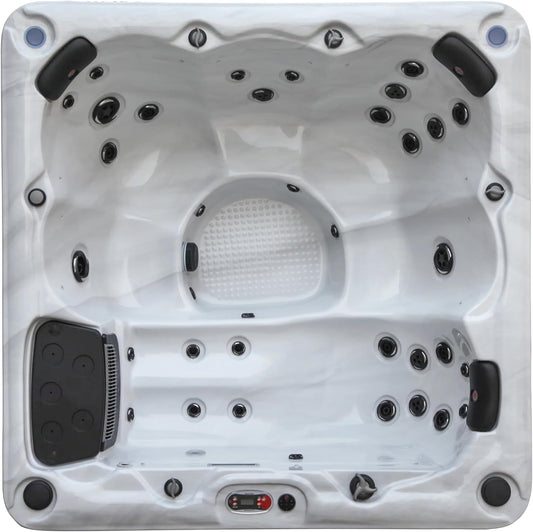
 Reduced
Winnipeg Hot Tub | 5-6 Person 35-Jet | 198 x 198 cm
6-Person 35 Jets 5 HP 198 x 198 cmRegular price £4,495.00Regular price£7,999.00Sale price £4,495.00Reduced -

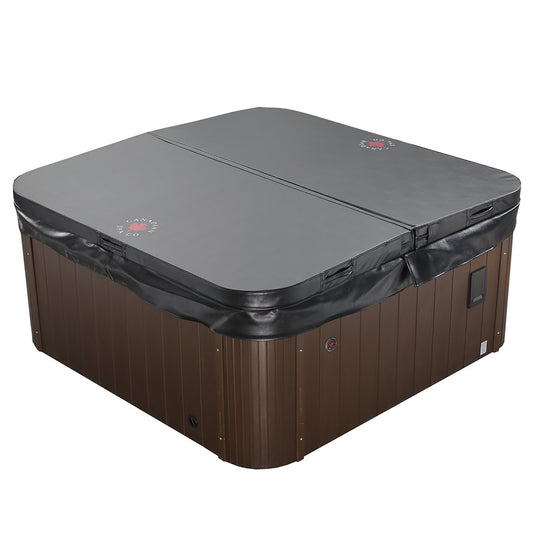
Ex-Display/Demo London SE 6-Person Hot Tub - 2yr Warranty
6-Person 44 Jets 10 HP 213 x 213 x 87 cmReducedEX-DISPLAYEx-Display/Demo London SE 6-Person Hot Tub - 2yr Warranty
6-Person 44 Jets 10 HP 213 x 213 x 87 cmRegular price £5,099.00Regular price£9,995.00Sale price £5,099.00ReducedEX-DISPLAY -
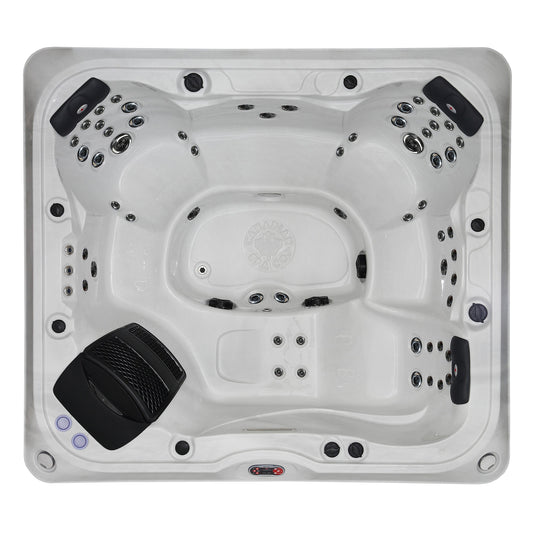
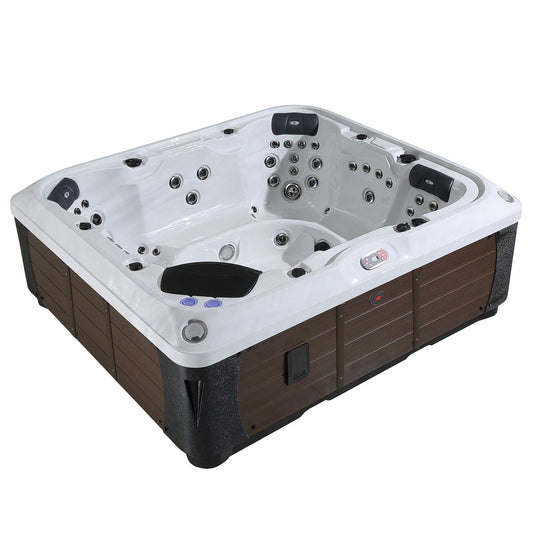 Reduced
Alberta SE Hot Tub | 6-Person 57-Jet | 240 x 216 cm
6-Person 57 Jets 10 HP 240 x 216 x 93 cmRegular price £8,995.00Regular price£11,995.00Sale price £8,995.00Reduced -
 Reduced
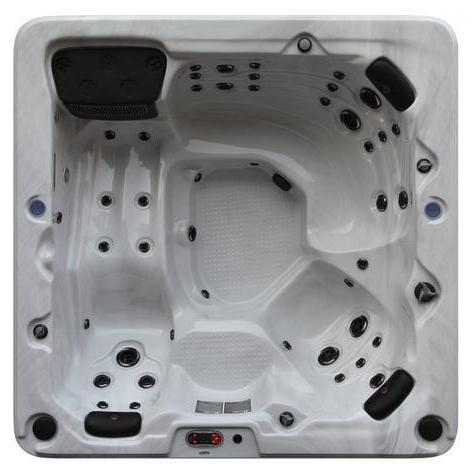
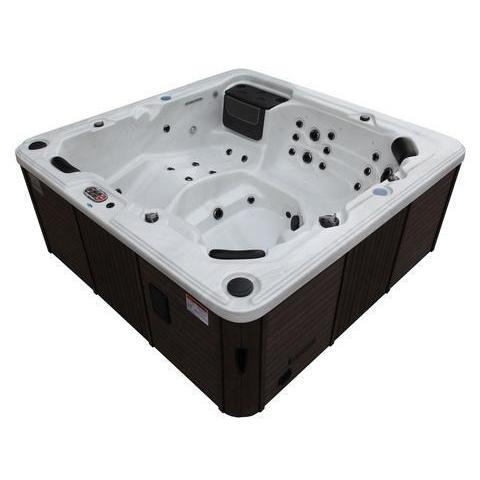
Toronto Hot Tub | 5-6 Person 44-Jet | 213 x 213 cm
6-Person 44 Jets 10 HP 213 x 213 x 82 cmRegular price £6,999.00Regular price£9,995.00Sale price £6,999.00Reduced -


London SE 6 Person Hot Tub | Canadian Spa Company UK
6-Person 44 Jets 10 HP 213 x 213 x 87 cmReducedLondon SE 6 Person Hot Tub | Canadian Spa Company UK
6-Person 44 Jets 10 HP 213 x 213 x 87 cmRegular price £6,999.00Regular price£9,995.00Sale price £6,999.00Reduced -
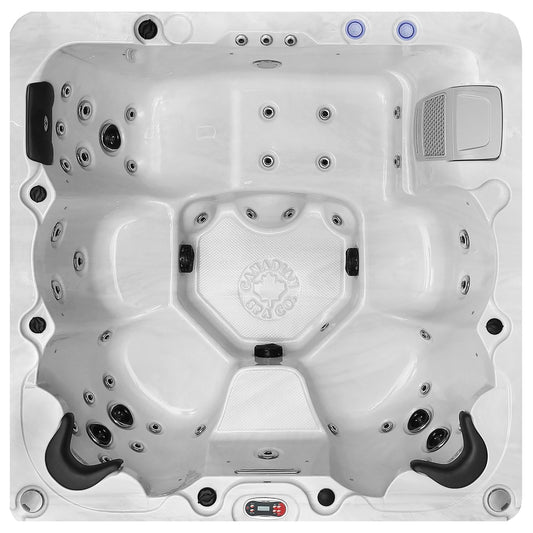
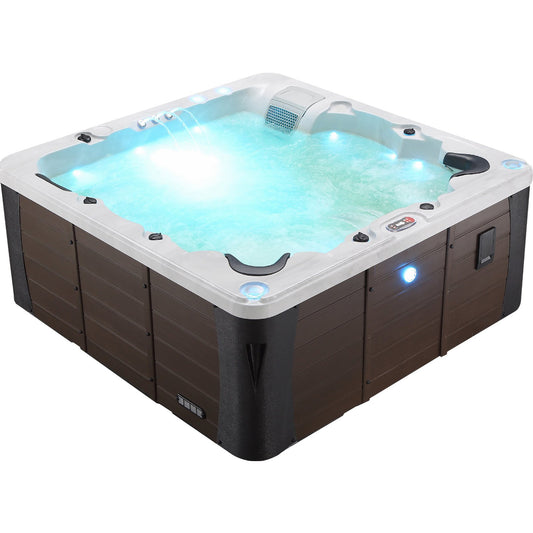
Erie Hot Tub | 6-Person 46-Jet Luxury Hot Tub | 213 x 213 cm LED Lighting, Built-in Bluetooth, Aromatherapy Canister, and Glacier Filtration
6-Person 46 Jets 10 HP 213 x 213 x 89 cmReducedErie Hot Tub | 6-Person 46-Jet Luxury Hot Tub | 213 x 213 cm LED Lighting, Built-in Bluetooth, Aromatherapy Canister, and Glacier Filtration
6-Person 46 Jets 10 HP 213 x 213 x 89 cmRegular price £6,999.00Regular price£11,999.00Sale price £6,999.00Reduced -
 Reduced
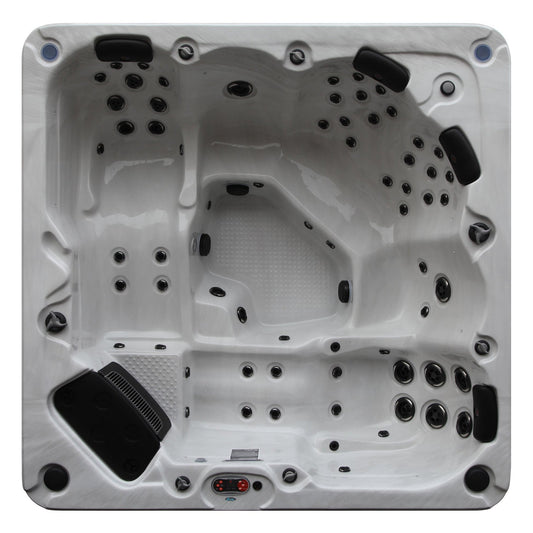
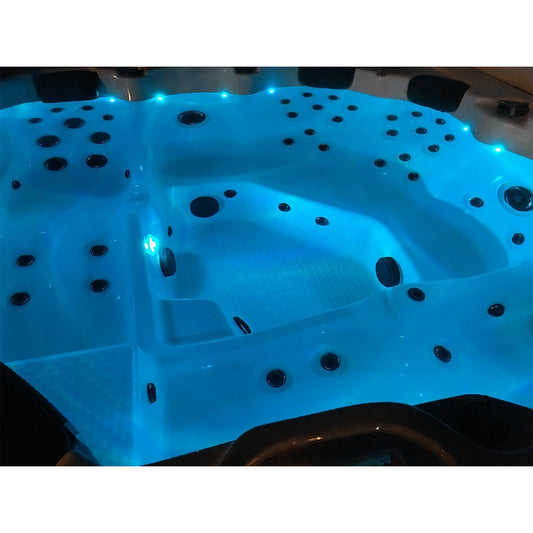
Vancouver Hot Tub | 6-Person 65-Jet | 227 x 227 cm
6-Person 65 Jets 10 HP 227 x 227 cmRegular price £6,899.99Regular price£10,900.00Sale price £6,899.99Reduced -

 Reduced
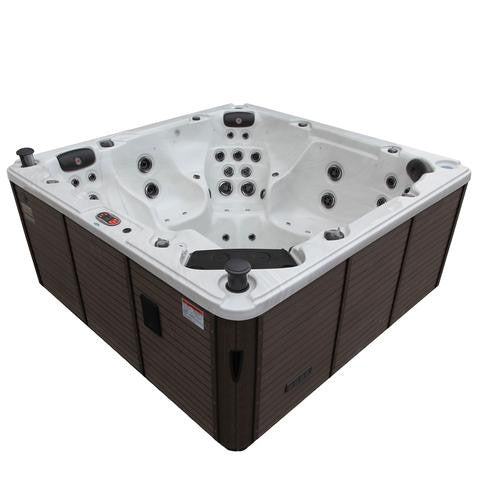
Niagara Hot Tub | 7-Person 60-Jet | 228 x 228 cm
7-Person 60 Jets 10 HP 228 x 228 x 99 cmRegular price £10,999.00Regular price£11,995.00Sale price £10,999.00Reduced -
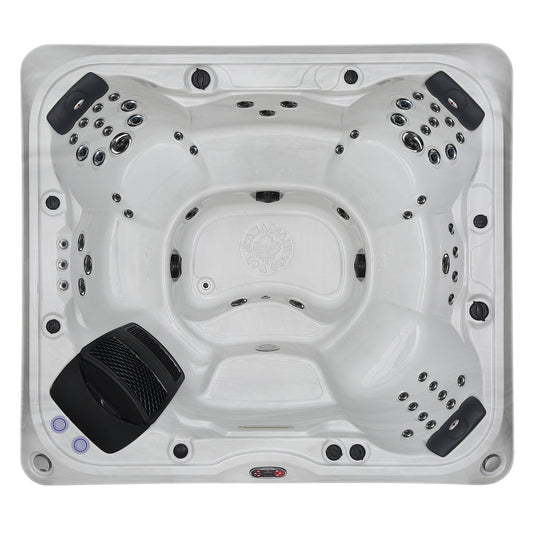
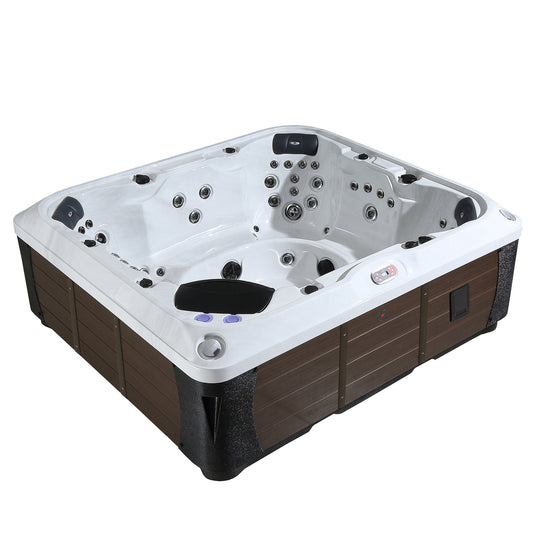
Kingston SE Hot Tub | 6-Person 55-Jet | 240 x 216 cm
6-Person 55 Jets 10 HP 240 x 216 cmReducedKingston SE Hot Tub | 6-Person 55-Jet | 240 x 216 cm
6-Person 55 Jets 10 HP 240 x 216 cmRegular price £8,995.00Regular price£11,995.00Sale price £8,995.00Reduced -
 Reduced
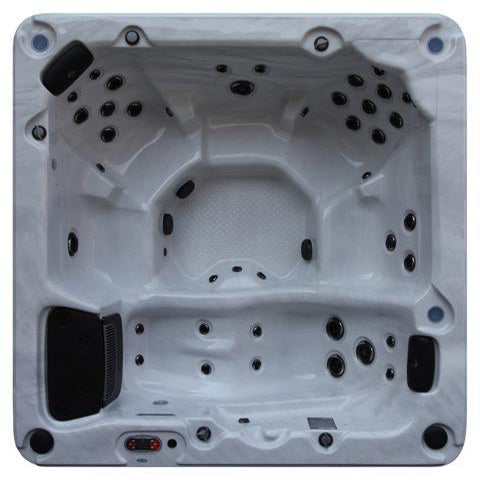
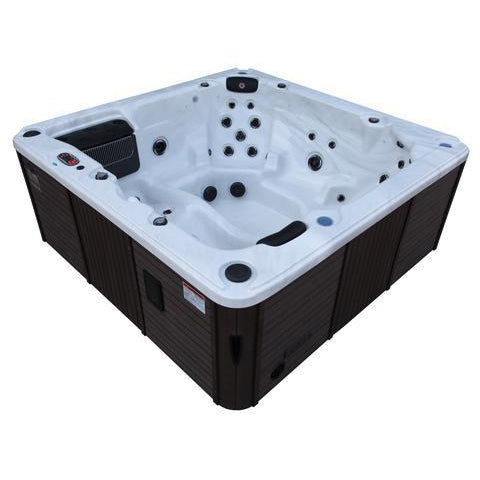
Thunder Bay Hot Tub | 5-6 Person 44-Jet | 219 x 219 cm
6-Person 44 Jets 10 HP 219 x 219 x 82 cmRegular price £6,999.00Regular price£8,999.00Sale price £6,999.00Reduced -

 Reduced
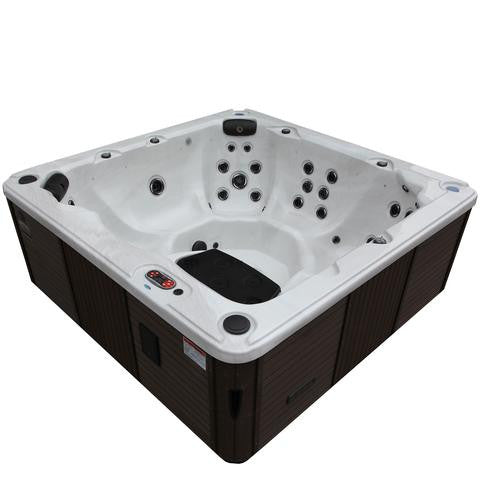
Victoria Hot Tub | 6-7 Person 44-Jet | 219 x 219 cm
7-Person 44 Jets 10 HP 219 x 219 cmRegular price £5,495.00Regular price£10,900.00Sale price £5,495.00Reduced


32A Hardwired Acrylic Hot Tubs: UK Buying Guide
This collection is part of the Canadian Spa Company UK range of hot tubs, swim spas, saunas and spa essentials. Compare options by fit for your space, running costs, insulation, warranty and ongoing maintenance requirements to make a better long-term choice.
If you need help choosing the right model or part, our support team can guide you on compatibility, delivery and aftercare.
About 32A Hardwired Acrylic Hot Tubs
A 32A hardwired supply is what unlocks the engineering that distinguishes our flagship 5–6 person hot tubs from the smaller plug-and-play range. The bigger 3kW heater (vs 2kW on plug-and-play) recovers temperature faster between sessions on a 6-person tub. The 32A supply also accommodates two-pump configurations and bigger jet counts for proper hydrotherapy — most models in the range support diversion to one side of the tub for higher pressure on a single seat.
The same insulation and water-care stack across the line: 5″→3″ tapered insulated cover, silver-foil reflection panels, 2.5″ plumbing throughout with no bend over 45°, Lucite® acrylic shell, Balboa BP-series control system. Some models include a heated air blower that actively pumps warm cabinet-cavity air into the jets for a 20–30% pressure lift on top of the pump output.
Install needs an electrician on site before delivery — 32A consumer-unit run, RCBO-protected, terminated at a fused isolator within reach of the spa pad. Sits on an existing patio or 3–4″ concrete base, no laser-levelling, 2″ slope tolerance over the spa’s length. Compare seating layouts, jet counts and full specs, below.
Who 32A is right for
When 32A is the honest answer
32A makes sense for specific use cases — and isn’t the right answer for a number of households that assume bigger is automatically better. Here’s where the install tier earns its electrician.
-
Owners who actually use the hydrotherapy
For therapy, such as post-training muscle work, lower-back recovery or chronic pain, choose the Niagara or Vancouver. Each side has its own 5HP pump plus a diverter that focuses pressure into one quarter of the tub. Two-pump models like the Toronto, Thunder Bay and Erie SE still give full power on every side.
-
Households that fill four-plus seats routinely
Friday-night neighbours, family weekends, four or more adults in the water at once. Driving jets across all seats simultaneously needs 32A pump HP — not a spec a 13A circuit can deliver. If the routine usage pattern is genuinely four-plus adults, the 32A tier is what the use case demands.
-
Multi-generational households
Grandparents on the lounger, adults on the benches, grandchildren on the corner step. A 5+ seat 32A tub gives everyone their own depth and jet strength. The lower cool-down seat suits older users and young children, so they can stay in the water while they adjust.
-
Three pump architectures, three massage characters
Single-pump (Winnipeg, Cambridge): a 50-50 social soak, with a diverter to send power to one side. Two-pump (Erie SE, London SE, Toronto, Thunder Bay, Victoria, Alberta SE, Kingston SE): a dedicated 5HP pump per side. Two-pump with per-side diverters (Niagara, Vancouver): focused pressure into one quarter. Every jet face turns like a dimmer.
-
Properties with consumer-unit headroom already
New-builds and recent renovations almost always have spare ways in the consumer unit, so adding a 32A circuit is a half-day job. Not sure about your board? A 30-minute electrician visit before you order will tell you. That is cheaper than finding out after the spa arrives.
-
Holiday lets at the 6+ guest tier
A listing that says “sleeps 6, hot tub included” but delivers a 3-seat tub gets marked down in reviews. At this level, guests expect the spa to match the listing. A proper 6-seat spa typically adds £15–£30 a night, which covers the extra running cost over a 40-week letting year.
Common questions
32A hardwired hot tub FAQ
Do I actually need a 32A hot tub?
Ask yourself: do you want a two-pump tub, 5HP continuous-duty pumps or 5+ seats? If yes to any of these, 32A is the right choice. That pump power will not run on 13A.
If you will usually have one to three adults and do not need two pumps or 5HP pumps, the 13A acrylic plug-and-play range is the simpler answer. Same Balboa BP control, same Mountain Pure™ UV-C plus ozone, same 5″→3″ cover, and no electrician needed.
What does 32A actually buy me over 13A?
Three things. (1) Pump power: 5HP continuous-duty pumps drawing 15.2A each only work on 32A.
(2) Three pump layouts: single-pump (Winnipeg, Cambridge) for social soaking; two-pump (Erie SE, London SE, Toronto, Thunder Bay, Victoria, Alberta SE, Kingston SE) for full power per side; or two-pump with per-side diverters (Niagara, Vancouver) for focused, chiropractor-class pressure.
(3) A 3kW heater instead of 2kW, which reheats bigger tubs noticeably faster between soaks.
What 32A does not buy: better insulation, a thicker cover, a different control system or cheaper daily running. The build is the same across the range.
How much does the 32A electrician install cost?
Usually £300–£700 for the spa circuit itself. That is a dedicated, RCD-protected run from the consumer unit to a rotary isolator near the spa. The price mostly depends on cable length and the state of your consumer unit.
If your consumer unit is full (common with 1990s or older boards), allow another £400–£800 for an upgrade. Book a 30-minute electrician visit before you order, so you know the real cost up front.
When should I book the electrician — before or after the spa arrives?
It depends on your delivery option.
With our install service, the cable must be ready at the spa pad on the day we arrive. Leave 4–5m coiled, with the end stripped back. Our installers will connect it temporarily, power the spa up and show you the chemicals and controls. Your electrician then comes back to sign it off.
With kerbside delivery, there is no deadline. We drop the spa at the kerb, and your electrician can wire it in any time after it is in place. We can talk them through the connection by phone.
What’s the standard electrical spec for a 32A spa circuit?
A 32A breaker in the consumer unit, RCD-protected, feeding an outdoor rotary isolator. From the isolator, run a 6mm armoured cable to just outside the spa’s footprint, not underneath. The cable enters through a side panel, not the base.
Leave 4–5m of spare cable coiled by the pad. Strip the end back and tape it, with live, neutral and earth ready to connect.
Your electrician may choose a different cable size for your distance or setup. That is fine, as long as the spa gets the full 32A, all three conductors are present and the circuit is RCD-protected.
Timing: with our install service, the cable must be ready on the day we arrive. With kerbside delivery, your electrician can wire it in any time after the spa is in place.
Does a 32A spa heat up faster than 13A?
Only slightly, for the same amount of water. In practice, heat-up times are about the same, because 32A tubs hold more water. They use a 3kW heater instead of 2kW, which handles the extra volume in roughly the same time.
From a cold mains fill, allow about 1°C an hour on either type: around a day in summer, and up to about 30 hours from a winter fill. Once it is up to temperature, the heater only runs a few hours a day on average.
Can I run a 32A tub on a 13A circuit temporarily?
No. The amperage is a hard limit, not a suggestion. A 5HP pump pulling 15.2A on a 13A circuit will trip the breaker, or can melt the cable if the breaker does not trip first.
If 32A will not work for your property, our 13A plug-and-play range is built for that. It has different pumps and a different model line-up.
What warranty do 32A hot tubs carry?
Warranty terms vary by product. You will find full details on each product page. UK service is run from our Redhill, Surrey office, by the same team that looks after our 13A and patio ranges.
One tip: keep up with filter changes and water care. More water through more jets means more work for the filter. Neglecting it is the quickest way to void a pump warranty.
Do I need a cover lifter at this size?
Yes, in practice it is essential. The 5″→3″ tapered hard-top cover weighs 30–40kg+ on a 5–6 seat tub, and more on a 7-seater. That is awkward to lift twice a day, especially in wind, rain or cold when it is wet.
A cover lifter costs £300–£600. It is the difference between using your tub every evening and avoiding it because the cover is a hassle. Include it in your budget from the start.
What base do I need for a 32A hot tub?
A level, load-bearing base of at least 3.5 × 3.5m. Go closer to 4 × 4m for 7-seat models, or if you need room for a cover lifter. An existing patio is fine if it can take 2.5–3 tonnes; if not, lay a concrete pad.
The shell copes with about 2″ of slope along its length, so no laser-levelling is needed. Do not put it on grass: uneven sinking stresses the corners and voids the warranty. Decking only works if it is engineered for the load.
How long is the lead time on 32A tubs?
Most tubs in the range ship from UK stock in 1–2 weeks, or sooner if your delivery date is flexible. Some larger or high-demand models take longer; each product page shows its lead time.
With our install service, have the electrician’s cable ready for the day we arrive (coiled at the pad, end stripped). With kerbside delivery, there is no deadline.
Will my garden access fit a 5+ seat tub?
Tubs this size are 220–245cm wide, so they will not fit through a standard 800–900mm garden gate. You need a clear path of at least 1,000mm from the kerb to the final spot, including any turns.
If access is tight, a crane lift over the fence is the usual answer. It typically costs £400–£800, depending on reach and obstacles. Measure the narrowest point and compare it with the spa’s width on the product page. We will flag any access problem when you order.
UK buying guide
32A hardwired hot tubs UK — buying guide
A 32A hardwired hot tub is the right buy for some households, and the wrong buy for many who think they need one. This guide helps you decide honestly: what 32A unlocks, what it does not, and which type suits you.
What 32A actually unlocks
Three things, and only three:
- Pump power. A real 5HP continuous-duty pump draws 15.2A while running. That is impossible on a 13A circuit and possible on 32A. Watch for BHP (brake horsepower) on other brands’ specs: it is a peak figure. The amperage shows which spec is real.
- Three pump layouts, each with its own massage feel. Single-pump models (Winnipeg, Cambridge) split flow 50-50 for a social soak; pull the diverter to send more power to one side. Two-pump models (Erie SE, London SE, Toronto, Thunder Bay, Victoria, Alberta SE, Kingston SE) give each side its own 5HP pump. The Niagara and Vancouver add a diverter on each side, focusing each pump into one quarter of the tub for our strongest massage. On every model, each jet face turns like a dimmer.
- A 3kW heater for bigger tubs. The 3kW heater (2kW on 13A) heats the larger water volume of 5+ seat tubs in about the same time.
What 32A does NOT buy you
Much less than most buyers expect:
- Better insulation. Same 5″→3″ tapered cover, silver-foil reflection panels and 2.5″ plumbing as the 13A range.
- A different control system. Same Balboa BP series and Mountain Pure UV-C plus ozone water care.
- Lower running costs. A 6-seat 32A tub costs about the same per day as a 4-seat 13A spa: both sit around £2–£2.50 a day. Heat loss depends on the cover and panels, which are the same on both.
The honest sizing test
- Do you want full pump power on every side, or focused per-side massage? If yes, choose a 32A two-pump model (Niagara or Vancouver for per-side focus). If not, the 13A acrylic range may be enough.
- How many adults will use the tub together in a typical week? Four or more, choose 32A. One to three, 13A is the simpler choice.
- How will your household change over the next 5 years? Teenagers bringing friends, retirement or holiday-let plans all point to a bigger tub. Size for everyday use, not the odd party.
- Is your consumer unit ready for a 32A circuit? New-builds and recent renovations usually are. Older boards may need an upgrade. A 30-minute electrician visit will tell you.
Common 32A install mistakes
- Forgetting the cable on install-service deliveries. If you booked our install service, the cable must be at the spa pad before we arrive: 4–5m coiled, end stripped, live, neutral and earth ready. Kerbside delivery has no deadline.
- Underestimating the cable run. A long run from the consumer unit can add to the cost. Measure it and get a quote first.
- Running the cable under the spa. The standard spec is 6mm armoured cable to a rotary isolator, with 4–5m spare coiled by the pad. The cable enters through a side panel, so it must end just outside the footprint, never underneath. Tell your electrician before they start.
- Not budgeting for a cover lifter. It costs £300–£600, but at 5+ seats it is close to essential.
When the 13A range is the better answer
Sometimes 32A just will not work. You might live in a listed building, have a full consumer unit with no upgrade path, or rent from a landlord who will not allow electrical work.
In those cases, our 13A acrylic plug-and-play range is built for the job. It has different pumps and models, but the same Balboa BP control, Mountain Pure water care and 5″→3″ cover. It is not a lesser spa, just a different design brief.
Where Canadian Spa fits
We have been a UK hot tub specialist since 1986, with our warehouse and service office in Redhill, Surrey. Our 32A range sits alongside our 13A, patio, inflatable, swim spa and chill therapy ranges, all with the same UK supply chain and service team.
If something goes wrong in year three, you call a UK office and speak to the same team that will still be here in year ten. Warranty, service visits and parts all come from one address.
Frequently asked
What’s the best 32A hot tub UK?
It depends on how you will use it. For focused, chiropractor-class massage, choose the Niagara, our flagship, or the Vancouver 65-jet. Both have two pumps and per-side diverters.
For full power on every side, choose from the Toronto, Thunder Bay, Victoria, Alberta SE, Kingston SE, Erie SE and London SE. For a single-pump social soak, pick the Winnipeg or Cambridge.
Each product page lists pumps, jets, size and power needs. Not sure? Call our Redhill team and talk us through how you will use it.
How much does a 32A hot tub cost to run?
Around £2–£2.50 a day, averaged over the year at current UK electricity prices. A 6-seat tub sits at the upper end.
Most heat is lost through the cover and insulation, which are the same across the range. So once it is up to temperature, a 32A tub costs about the same to run as a 13A one.
32A vs 13A — which should I buy?
Choose 32A if you want full pump power on every side, 5HP continuous-duty pumps or 5+ seats.
Choose 13A if you will usually have 1–3 adults, do not need two pumps, have limited electrics, or would rather not involve an electrician. Both ranges share the same Balboa BP control, Mountain Pure water care and 5″→3″ cover. The difference is what the power supply unlocks.
Do I need an electrician for a 32A hot tub?
Yes. You need a dedicated, RCD-protected 32A circuit from the consumer unit to a rotary isolator near the spa. It is about half a day’s work for a qualified electrician, typically £300–£700 depending on cable length and your consumer unit.
With our install service, the cable must be ready at the spa pad on the day we arrive. Our installers can connect it temporarily, power the spa up and show you how to use it. They are not electricians, so your electrician comes back afterwards to sign it off.
With kerbside delivery, your electrician can wire the spa once it is in place. We can guide them by phone if needed.
What base do I need for a 32A hot tub?
A level, load-bearing base of at least 3.5 × 3.5m, ideally 4 × 4m for access and a cover lifter. An existing patio is fine if it can take 2.5–3 tonnes; if not, lay a concrete pad.
The shell copes with about 2″ of slope, so no laser-levelling is needed. Do not use grass. Decking only works if it is engineered for the load.